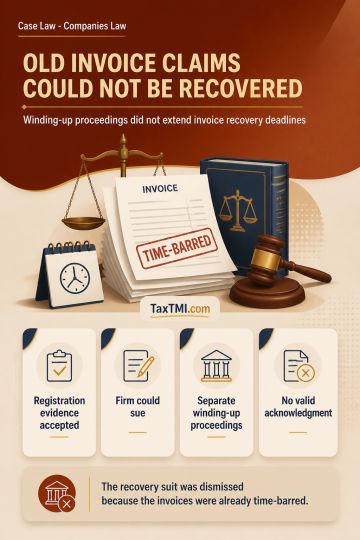
Invoice-based recovery claims remain time-barred despite separate winding-up proceedings, absent valid acknowledgment or part-payment of the disputed ...
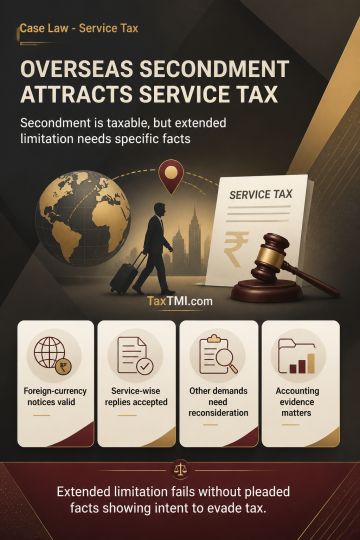
Extended limitation fails without specific suppression allegations, while overseas employee secondment remains taxable as manpower supply within norma...
Time-share accommodation classification excludes Club or Association Service where purchasers receive contractual occupancy rights without genuine mem...
CENVAT credit for trading requires reversal, while taxable-service rental credit remains proportionately available and limitation issues await resolut...
Page of 4792
Press 'Enter' after typing page number.
61 to 80 of 95833 Results
❮
❯
❯❯
0 / 200
Expand Note
Add to Folder
No Folders have been created
+
Are you sure you want to delete "My most important" ?
The Assessee, a regular investor in shares, made investments and sold a particular script when prices were high, resulting in Long Term Capital Gains (LTCG). The Assessing Officer (AO) treated the LTCG as bogus and made an addition u/s 68, relying solely on the report and statements recorded by the Investigating Wing, without conducting an independent inquiry or corroborating the evidence. The ITAT held that merely identifying a script as a penny stock does not render all transactions in it as bogus. The Assessee had produced documents showing genuine transactions, and there was no adverse report from SEBI or other authorities against the script. The AO erred in denying the Assessee's request for cross-examination of the person alleging accommodation entries through LTCG. The ITAT ruled in favor of the Assessee, emphasizing the need for an independent inquiry by the AO and corroboration of evidence from other sources before treating transactions as bogus.
The Assessee, a regular investor in shares, made investments and sold a particular script when prices were high, resulting in Long Term Capital Gains (LTCG). The Assessing Officer (AO) treated the LTCG as bogus and made an addition u/s 68, relying solely on the report and statements recorded by the Investigating Wing, without conducting an independent inquiry or corroborating the evidence. The ITAT held that merely identifying a script as a penny stock does not render all transactions in it as bogus. The Assessee had produced documents showing genuine transactions, and there was no adverse report from SEBI or other authorities against the script. The AO erred in denying the Assessee's request for cross-examination of the person alleging accommodation entries through LTCG. The ITAT ruled in favor of the Assessee, emphasizing the need for an independent inquiry by the AO and corroboration of evidence from other sources before treating transactions as bogus.
Note: It is a system-generated summary and is for quick reference only.
 TaxTMI
 of 4792










 Join Channel


 TaxTMI

