Origin Declaration authentication governs preferential tariff claims under India-UK CETA, requiring a validated reference number before import clearan...
Separate assessment orders for different years remain valid when distinct notices and hearing opportunities prevent prejudice from combined proceeding...
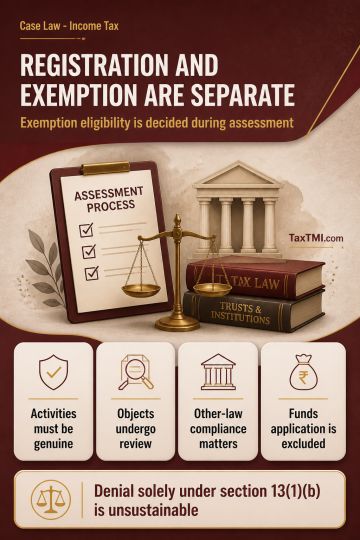
Defined public benefit can retain charitable character; registration renewal requires examining genuine activities and legal compliance, not surplus a...
Capital reduction is distinct from share buy-back, preventing buy-back tax; restructuring interest and related business deductions also survive scruti...
The High Court held that the capital grant subsidy or viability gap funding provided by the National Highways Authority of India (NHAI) to its Concessionaires for infrastructure projects does not constitute payment for 'work' u/s 194C of the Income Tax Act, 1961, and hence, is not subject to tax deduction at source. The key points are: The Concessionaire's primary obligation is to raise funds and implement the project, while NHAI extends financial aid through viability gap funding. Section 194C requires tax deduction on sums paid to a contractor for carrying out 'work', which implies a physical or tangible activity involving labor. The capital grant subsidy is not payment for work per se but financial support from NHAI for creating a public utility asset. The Concessionaire owns and exploits the asset during the concession period to recoup investment. The viability gap funding is not credited to the Concessionaire's account but directly to the Escrow Account, hence not attracting Section 194C(2). The High Court correctly concluded that the viability gap funding cannot be construed as payment for work undertaken by the contractor u/s 194C.
The High Court held that the capital grant subsidy or viability gap funding provided by the National Highways Authority of India (NHAI) to its Concessionaires for infrastructure projects does not constitute payment for 'work' u/s 194C of the Income Tax Act, 1961, and hence, is not subject to tax deduction at source. The key points are: The Concessionaire's primary obligation is to raise funds and implement the project, while NHAI extends financial aid through viability gap funding. Section 194C requires tax deduction on sums paid to a contractor for carrying out 'work', which implies a physical or tangible activity involving labor. The capital grant subsidy is not payment for work per se but financial support from NHAI for creating a public utility asset. The Concessionaire owns and exploits the asset during the concession period to recoup investment. The viability gap funding is not credited to the Concessionaire's account but directly to the Escrow Account, hence not attracting Section 194C(2). The High Court correctly concluded that the viability gap funding cannot be construed as payment for work undertaken by the contractor u/s 194C.
Note: It is a system-generated summary and is for quick reference only.
 TaxTMI
 of 4803


















 Join Channel


 TaxTMI
