Defined public benefit can retain charitable character; registration renewal requires examining genuine activities and legal compliance, not surplus a...
Capital reduction is distinct from share buy-back, preventing buy-back tax; restructuring interest and related business deductions also survive scruti...
Transfer pricing and tax deductions upheld on established principles, while employee contributions and warranty provisions returned for fresh examinat...
Captive transfer pricing relies on industrial consumer tariffs, while genuine quotations can benchmark effluent treatment transfers under the Other Me...
Specific tariff classification for ophthalmic instruments and extended limitation principles determine the treatment of duty demands, confiscation, an...
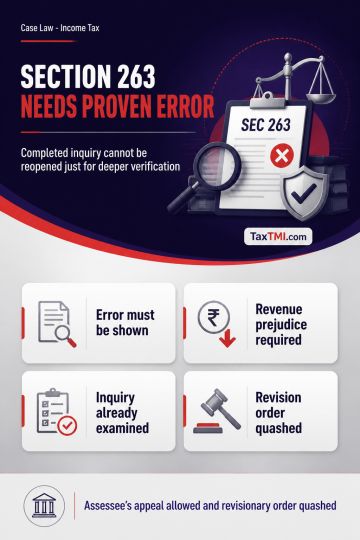
The assessee society's activities were initially considered commercial by the Commissioner of Income Tax (CIT) under the second proviso to Section 2(15) of the Income Tax Act. However, the Income Tax Appellate Tribunal (ITAT) held that the society's primary objective was to secure and promote the business interests of its members, which does not necessarily imply a commercial nature. The ITAT observed that the society was formed as an initiative of the Government of India to bring stakeholders together, ultimately benefiting consumers. Despite including private sector members, the society's role as a facilitator for the hydrocarbon industry does not make its activities commercial. The expenditure statements did not indicate any funds utilized for procuring business for members or promoting their financial interests. The ITAT concluded that the Revisional Authority's order lacked legal basis and was based on conjectures beyond the scope of Section 263, ruling in favor of the assessee.
The assessee society's activities were initially considered commercial by the Commissioner of Income Tax (CIT) under the second proviso to Section 2(15) of the Income Tax Act. However, the Income Tax Appellate Tribunal (ITAT) held that the society's primary objective was to secure and promote the business interests of its members, which does not necessarily imply a commercial nature. The ITAT observed that the society was formed as an initiative of the Government of India to bring stakeholders together, ultimately benefiting consumers. Despite including private sector members, the society's role as a facilitator for the hydrocarbon industry does not make its activities commercial. The expenditure statements did not indicate any funds utilized for procuring business for members or promoting their financial interests. The ITAT concluded that the Revisional Authority's order lacked legal basis and was based on conjectures beyond the scope of Section 263, ruling in favor of the assessee.
Note: It is a system-generated summary and is for quick reference only.
 TaxTMI
 of 4805



















 Join Channel


 TaxTMI

