Prolonged sterilisation of development rights supports capital-gains treatment, while business-income disallowances cannot govern capital-gains comput...
Additional evidence in transfer pricing dispute leads to fresh examination, while tax deductions, TDS credit, fee and refund interest require verifica...
Category II AIF pass-through taxation preserves non-business income character; investment receipts cannot be reclassified without applying recognised ...
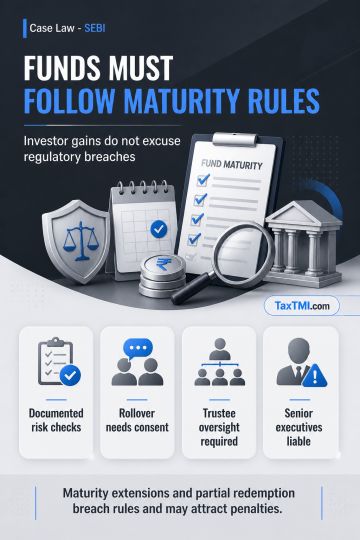
Mutual fund maturity rules require proper rollover, redemption, disclosure, and due diligence; investor gains cannot excuse regulatory breaches or pen...
Threshold exemption excludes exempt services, while stamp-paper purchases avoid reverse charge; consequential service tax penalties were also set asid...
Income estimation based on percentage of gross receipts - CIT(A) applied 12.5% net profit on gross receipts, assessee claimed thin margins in advertisement business. ITAT held some guesswork inevitable without financial data. CIT(A) lacked material for 12.5%, assessee failed to substantiate lower 1.5-2% claim. Section 44AD deems 8% of turnover as business income for eligible assessees based on empirical data. Guided by equity, ITAT considered 8% of gross receipts fair estimation, modifying CIT(A)'s 12.5% to 8%. Assessee's appeal partly allowed.
Income estimation based on percentage of gross receipts - CIT(A) applied 12.5% net profit on gross receipts, assessee claimed thin margins in advertisement business. ITAT held some guesswork inevitable without financial data. CIT(A) lacked material for 12.5%, assessee failed to substantiate lower 1.5-2% claim. Section 44AD deems 8% of turnover as business income for eligible assessees based on empirical data. Guided by equity, ITAT considered 8% of gross receipts fair estimation, modifying CIT(A)'s 12.5% to 8%. Assessee's appeal partly allowed.
Note: It is a system-generated summary and is for quick reference only.
 TaxTMI
 of 4805



















 Join Channel


 TaxTMI
