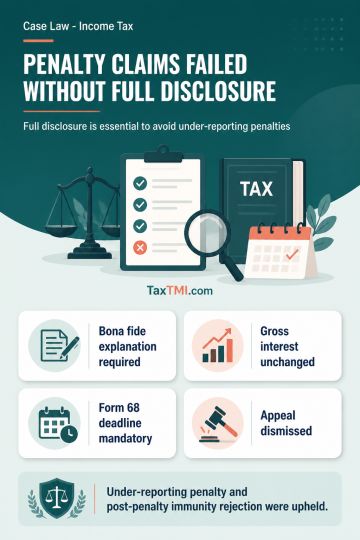
Bona fide disclosure requirements govern under-reporting penalties, and post-penalty immunity applications cannot secure available statutory protectio...
Certificate-of-origin verification procedure governs preferential customs benefits; denial without retroactive verification was set aside with consequ...
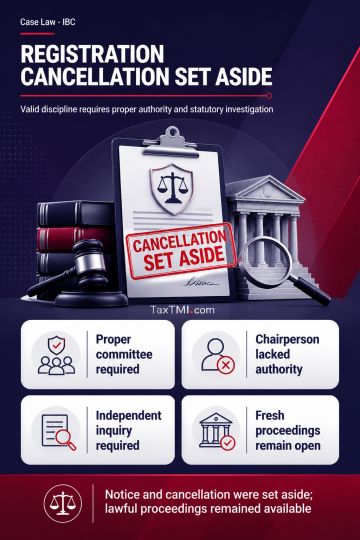
Disciplinary Committee jurisdiction and mandatory investigation requirements invalidated cancellation of an insolvency professional's registration and...
Retention of seized property survives where recorded reasons support proceeds of crime, while stayed investigation periods are excluded from limitatio...
Specified income of Baddi Barotiwala Nalagarh Development Authority receives conditional tax exemption, retrospectively covering its designated assess...
Page of 4805
Press 'Enter' after typing page number.
1221 to 1240 of 96092 Results
❮
❯
❯❯
0 / 200
Expand Note
Add to Folder
No Folders have been created
+
Are you sure you want to delete "My most important" ?
The National Company Law Appellate Tribunal (NCLAT) has remanded the case back to the Adjudicating Authority (AA) to examine and decide the issues in a comprehensive manner, including the application of the appellant in I.A. No. 1412 of 2023, preferably within four weeks. The NCLAT held that there is an absolute bar on recovery of any property occupied or possessed by the Corporate Debtor u/s 14(1)(d) of the Insolvency and Bankruptcy Code. The AA had passed a non-speaking order merely based on the consent of the Resolution Professional (RP) to release the property, without examining the maintainability of such applications by the owner/lessor in view of Section 14(1)(d). The Committee of Creditors (CoC) did not appear to have taken a final decision with proper voting regarding the vacation of the registered office. The RP's decision to release the property was his own and not confirmed by the CoC. The NCLAT found that the AA should have first examined whether it is possible to allow such applications in view of the express provisions of Section 14(1)(d), even if supported by the CoC. The appeal was allowed.
The National Company Law Appellate Tribunal (NCLAT) has remanded the case back to the Adjudicating Authority (AA) to examine and decide the issues in a comprehensive manner, including the application of the appellant in I.A. No. 1412 of 2023, preferably within four weeks. The NCLAT held that there is an absolute bar on recovery of any property occupied or possessed by the Corporate Debtor u/s 14(1)(d) of the Insolvency and Bankruptcy Code. The AA had passed a non-speaking order merely based on the consent of the Resolution Professional (RP) to release the property, without examining the maintainability of such applications by the owner/lessor in view of Section 14(1)(d). The Committee of Creditors (CoC) did not appear to have taken a final decision with proper voting regarding the vacation of the registered office. The RP's decision to release the property was his own and not confirmed by the CoC. The NCLAT found that the AA should have first examined whether it is possible to allow such applications in view of the express provisions of Section 14(1)(d), even if supported by the CoC. The appeal was allowed.
Note: It is a system-generated summary and is for quick reference only.
 TaxTMI
 of 4805















 Join Channel


 TaxTMI