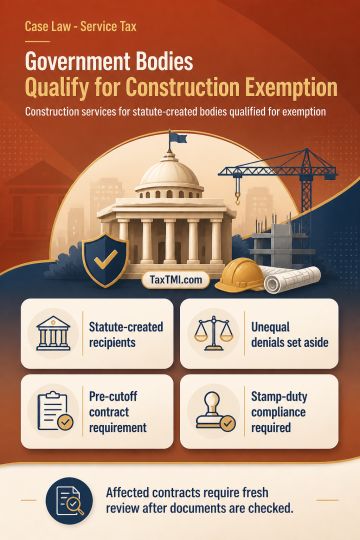
Governmental authority status supports construction-service exemption, while pre-cutoff contract and stamp-duty compliance requires verification on re...
Automated Free Sale and Commerce Certificates enable paperless processing while retaining risk-based manual verification for selected exporter applica...
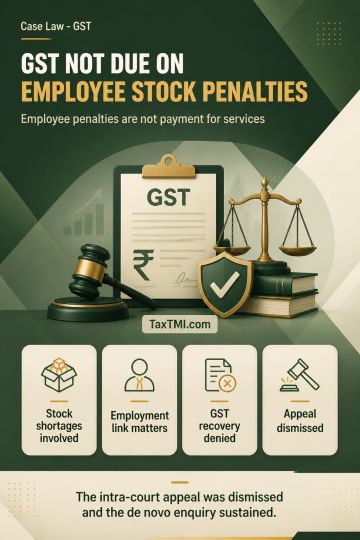
Employee stock-shortage penalties do not constitute consideration for services, preventing GST collection under Schedule II in employment relationship...
The summary focuses on the challenge to proceedings initiated u/s 129 of the CGST Act read with Section 20 of the IGST Act, involving a penalty order for the movement of goods without proper documents. The key points are: The goods were accompanied by dated documents, but the petitioner's registration was suspended by the jurisdictional authorities after the documents were issued. A coordinate Bench of the High Court, in the Halder Enterprises case, held that if goods are found with proper tax invoices and e-way bills, the circular dated 31.12.2018 would apply, deeming the petitioner as the owner, and the goods should be released u/s 129(1)(a) of the CGST Act. In the present case, the respondents did not dispute the presence of proper tax invoices and e-way bills, and the action was solely based on the suspension of registration. The High Court, relying on its previous decisions, set aside the impugned order and allowed the petition.
The summary focuses on the challenge to proceedings initiated u/s 129 of the CGST Act read with Section 20 of the IGST Act, involving a penalty order for the movement of goods without proper documents. The key points are: The goods were accompanied by dated documents, but the petitioner's registration was suspended by the jurisdictional authorities after the documents were issued. A coordinate Bench of the High Court, in the Halder Enterprises case, held that if goods are found with proper tax invoices and e-way bills, the circular dated 31.12.2018 would apply, deeming the petitioner as the owner, and the goods should be released u/s 129(1)(a) of the CGST Act. In the present case, the respondents did not dispute the presence of proper tax invoices and e-way bills, and the action was solely based on the suspension of registration. The High Court, relying on its previous decisions, set aside the impugned order and allowed the petition.
Note: It is a system-generated summary and is for quick reference only.
 TaxTMI
  TaxTMI
 of 4828






 Join Channel


