Arrest safeguards require disclosed grounds, relative intimation and transit remand, while duplicate prosecution under the CGST framework is unsustain...
Document Identification Number defects can invalidate GST assessments, with delayed challenges entertained conditionally where patent irregularities e...
Windmill commissioning evidence supported higher depreciation where grid connection and electricity generation proved operational use before the relev...
Pharmaceutical promotion and transfer-pricing comparability principles limited disallowances, while uncorroborated search allegations and unsupported ...
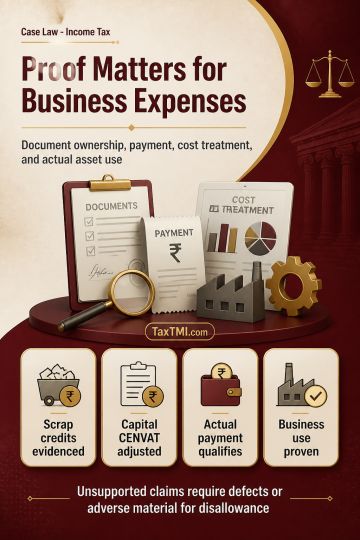
Business expenditure substantiation supports scrap credits, statutory payments and expense claims, while depreciation requires proof of actual busines...
Disallowing interest expenditure claimed u/s 36(1)(iii) when the assessee firm has interest-free funds and the amount overdrawn by partners. The Tribunal held that since the assessee firm had interest-free funds sufficient to cover the amounts overdrawn by partners, as evident from audited accounts, the disallowance of interest expenditure by the Assessing Officer was unjustified. The Tribunal relied on decisions of the Bombay High Court and its own coordinate Bench, which established that if an assessee has sufficient interest-free funds and advances are made without charging interest, disallowance u/s 36(1)(iii) on such advances for notional interest is not permissible. The Tribunal found no merit in the Revenue's appeal, concluding that the Assessing Officer's adverse inference was a misreading of facts contrary to documented evidence provided by the assessee.
Disallowing interest expenditure claimed u/s 36(1)(iii) when the assessee firm has interest-free funds and the amount overdrawn by partners. The Tribunal held that since the assessee firm had interest-free funds sufficient to cover the amounts overdrawn by partners, as evident from audited accounts, the disallowance of interest expenditure by the Assessing Officer was unjustified. The Tribunal relied on decisions of the Bombay High Court and its own coordinate Bench, which established that if an assessee has sufficient interest-free funds and advances are made without charging interest, disallowance u/s 36(1)(iii) on such advances for notional interest is not permissible. The Tribunal found no merit in the Revenue's appeal, concluding that the Assessing Officer's adverse inference was a misreading of facts contrary to documented evidence provided by the assessee.
Note: It is a system-generated summary and is for quick reference only.
 TaxTMI
 of 4788


















 Join Channel


 TaxTMI