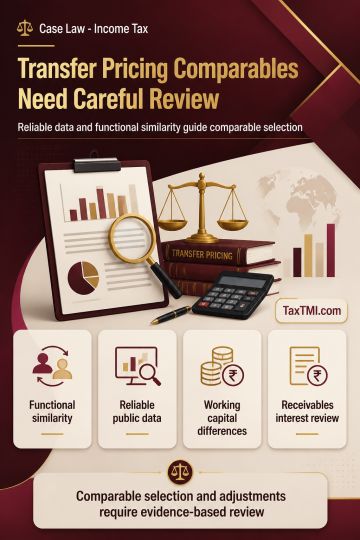
Transfer pricing comparability requires functional alignment, reliable financial data, and careful review of working capital and receivables adjustmen...
Transfer pricing rules require benchmarking corporate guarantees and associated-enterprise advances, while invalid domestic-transaction adjustments ca...
Prospective sugar export prohibition required registered letters of credit; private contracts and export quotas created no enforceable continuation ri...
Retroactive interim-moratorium exclusion permits protective asset disclosure and preservation measures against personal guarantors pending arbitration...
Once the main demand of duty case is settled under the Sabka Vishwas Legacy Dispute Resolution Scheme (SVLDRS) 2019, penalties imposed on co-noticees cannot be sustained, even if they did not file a declaration under the scheme. As per the scheme, there is a waiver of penalties on the main assessee against whom the demand was confirmed, as well as on other co-noticees. This position is established by the judgments in the cases of Anil K Modani and Subhash Panchal, where it was held that upon settlement of the main duty evasion case under SVLDRS 2019, penalties on co-appellants/co-noticees shall not survive. These Division Bench judgments prevail over the contrary view expressed by the Single Member Bench in the case of Four R Associates and others. Consequently, the penalties imposed on the appellants (co-noticees) are set aside, and the appeals are allowed.
Once the main demand of duty case is settled under the Sabka Vishwas Legacy Dispute Resolution Scheme (SVLDRS) 2019, penalties imposed on co-noticees cannot be sustained, even if they did not file a declaration under the scheme. As per the scheme, there is a waiver of penalties on the main assessee against whom the demand was confirmed, as well as on other co-noticees. This position is established by the judgments in the cases of Anil K Modani and Subhash Panchal, where it was held that upon settlement of the main duty evasion case under SVLDRS 2019, penalties on co-appellants/co-noticees shall not survive. These Division Bench judgments prevail over the contrary view expressed by the Single Member Bench in the case of Four R Associates and others. Consequently, the penalties imposed on the appellants (co-noticees) are set aside, and the appeals are allowed.
Note: It is a system-generated summary and is for quick reference only.
 TaxTMI
 of 4782
















 Join Channel


 TaxTMI