Prolonged sterilisation of development rights supports capital-gains treatment, while business-income disallowances cannot govern capital-gains comput...
Additional evidence in transfer pricing dispute leads to fresh examination, while tax deductions, TDS credit, fee and refund interest require verifica...
Category II AIF pass-through taxation preserves non-business income character; investment receipts cannot be reclassified without applying recognised ...
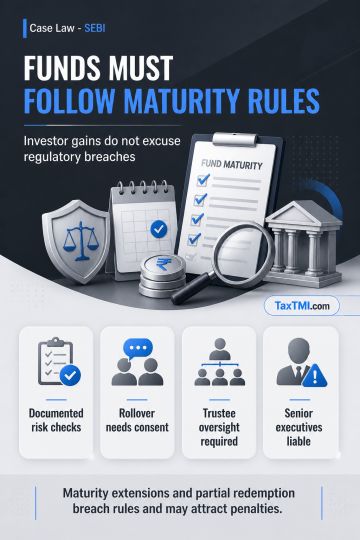
Mutual fund maturity rules require proper rollover, redemption, disclosure, and due diligence; investor gains cannot excuse regulatory breaches or pen...
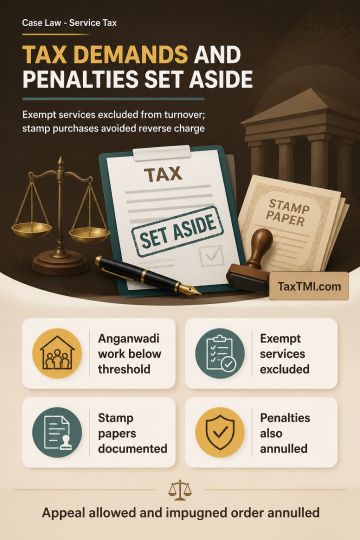
Threshold exemption excludes exempt services, while stamp-paper purchases avoid reverse charge; consequential service tax penalties were also set asid...
One appeal filed by the Revenue against 7 Bills of Entry is not maintainable. As per Rule 6(A) of the CESTAT Procedure Rules, 1982, when the Commissioner (Appeals) passes a common order-in-appeal disposing of appeals covering multiple Bills of Entry, the appellant is required to file separate appeals for each Bill of Entry, as each Bill of Entry is an assessment order in itself. This interpretation aligns with the Ahmedabad Bench's ruling in CMR Nikkie India Pvt Ltd case and the Jammu & Kashmir High Court's interpretation in CGST & CE, Jammu vs. M/s Narbada Industries case, which clarified that monetary thresholds apply to individual appeals, not the aggregate amount. Consequently, the Revenue is directed to file 7 separate appeals instead of one appeal if they wish to challenge the common order-in-appeal.
One appeal filed by the Revenue against 7 Bills of Entry is not maintainable. As per Rule 6(A) of the CESTAT Procedure Rules, 1982, when the Commissioner (Appeals) passes a common order-in-appeal disposing of appeals covering multiple Bills of Entry, the appellant is required to file separate appeals for each Bill of Entry, as each Bill of Entry is an assessment order in itself. This interpretation aligns with the Ahmedabad Bench's ruling in CMR Nikkie India Pvt Ltd case and the Jammu & Kashmir High Court's interpretation in CGST & CE, Jammu vs. M/s Narbada Industries case, which clarified that monetary thresholds apply to individual appeals, not the aggregate amount. Consequently, the Revenue is directed to file 7 separate appeals instead of one appeal if they wish to challenge the common order-in-appeal.
Note: It is a system-generated summary and is for quick reference only.
 TaxTMI
 of 4794


















 Join Channel


 TaxTMI
