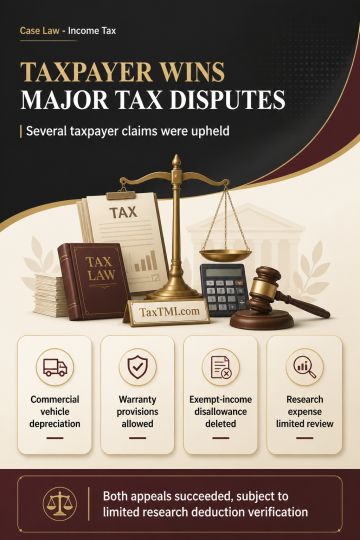
Commercial vehicle depreciation, scientifically determined warranty provisions and exempt-income disallowances were resolved in favour of the taxpayer...
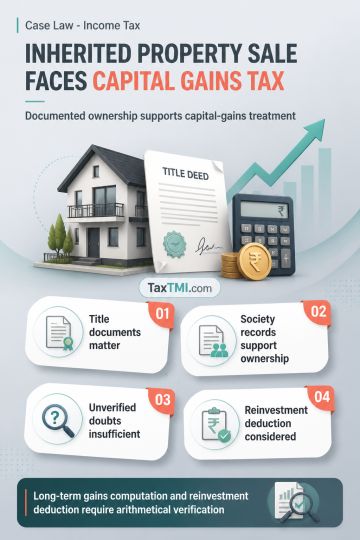
Inherited property sale proceeds require capital-gains treatment where ownership is supported by evidence, not suspicion or unverified signature doubt...
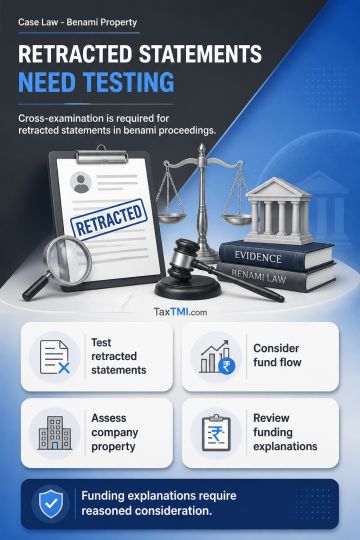
Cross-examination of retracted statements is essential where foundational evidence supports a benami allegation and documented funding explanations re...
Capital-goods exemption covers plant-modernisation accessories, while the import restriction applies only to earlier capital-goods components and spar...
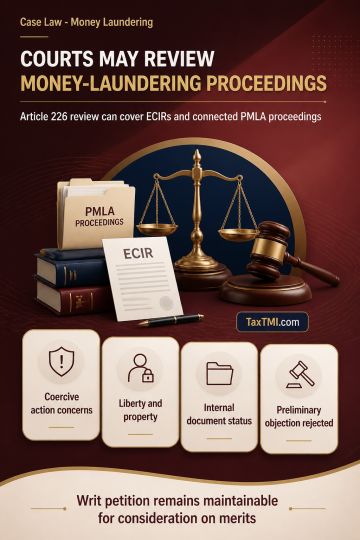
Constitutional judicial review permits challenges to ECIRs and connected money-laundering proceedings where coercive action affects fundamental intere...
The case pertains to the refund of tax paid by the petitioner under the 'Inverted Duty Structure' in the Goods and Services Tax (GST) regime. The petitioner filed an application for refund on 12.04.2023, beyond the limitation period, claiming a refund of Integrated Goods and Services Tax (IGST) paid. The High Court held that when the amounts in the credit ledger were set off against the demand, their character changed to that of tax recovered by the department. An appeal against the demand raised by the Assessing Officer was allowed on 20.02.2022, and the order was communicated on 15.08.2022. The second Explanation to Section 54 of the GST Act states that when tax becomes refundable due to an order of the Appellate Authority, the relevant date is the date of communication of such order, which in this case was 15.08.2022. The petitioner's online application could not be uploaded due to a technical glitch, and the Government contended that the 'Inverted Duty Structure' refund is possible only for two years. The High Court allowed the petition.
The case pertains to the refund of tax paid by the petitioner under the 'Inverted Duty Structure' in the Goods and Services Tax (GST) regime. The petitioner filed an application for refund on 12.04.2023, beyond the limitation period, claiming a refund of Integrated Goods and Services Tax (IGST) paid. The High Court held that when the amounts in the credit ledger were set off against the demand, their character changed to that of tax recovered by the department. An appeal against the demand raised by the Assessing Officer was allowed on 20.02.2022, and the order was communicated on 15.08.2022. The second Explanation to Section 54 of the GST Act states that when tax becomes refundable due to an order of the Appellate Authority, the relevant date is the date of communication of such order, which in this case was 15.08.2022. The petitioner's online application could not be uploaded due to a technical glitch, and the Government contended that the 'Inverted Duty Structure' refund is possible only for two years. The High Court allowed the petition.
Note: It is a system-generated summary and is for quick reference only.
 TaxTMI
 of 4782









 Join Channel


 TaxTMI
