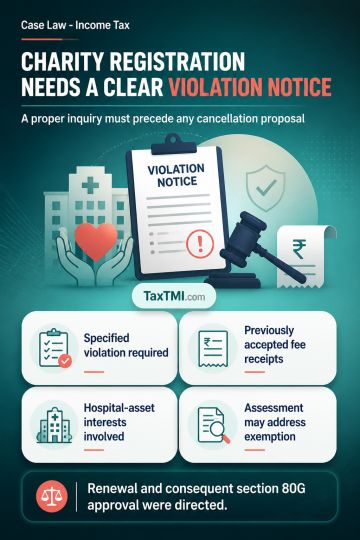
Charitable trust registration requires a specified-violation notice; settled cash deposits and related-party payments did not justify cancellation or ...
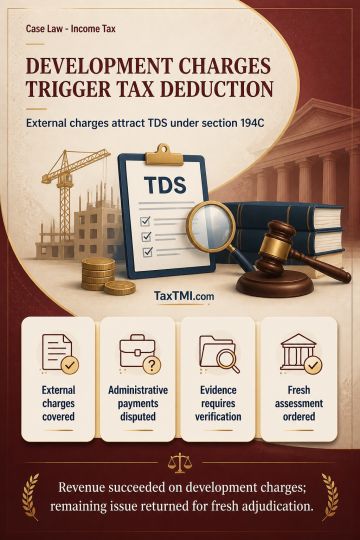
External development charges trigger TDS under section 194C, while disputed administrative payments require factual verification and fresh adjudicatio...
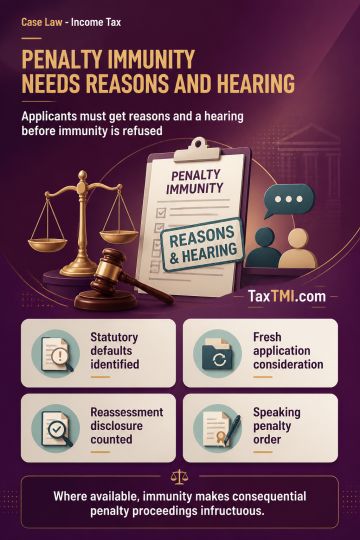
Section 270AA penalty immunity requires identified statutory defaults and a hearing before rejection; reassessment disclosure may constitute under-rep...
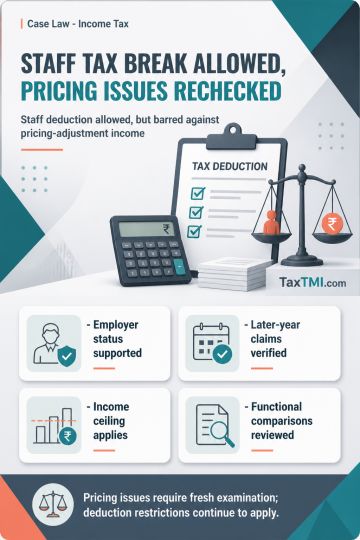
Section 80JJAA employee-cost deduction allowed for deployed staff but barred against transfer-pricing income enhancement, with pricing issues remanded...
Transfer-pricing methodology protects commercially genuine associated-enterprise payments, while pre-2016 secondary adjustments and related notional i...
Negative liens over operating assets can constitute international transactions requiring arm's-length pricing reflecting restricted borrowing and expa...
Cross-examination rights in Customs Broker revocation inquiries require witness examination; procedural denial may be cured through fresh adjudication...
The development fund received from students, apart from tuition fees, is treated as a capital receipt or corpus donation, not a revenue receipt. The fund is utilized for creating capital assets like school buildings and infrastructure, fulfilling the society's objectives. The litmus test for a charitable institution is the application of funds, not the source of contributions. If the development fees are used for infrastructure creation, they are considered capital receipts. The advances given to staff, suppliers, and sister concerns were not treated as misappropriation of funds or investments violating Section 11(5) and 13(1)(d). The institutions receiving non-interest-bearing loans are also registered u/s 12AA and controlled by the same management, ruling out tax avoidance schemes. The rejection of accounts u/s 145(3) and the ad-hoc disallowance of 20% by the Assessing Officer, reduced to 10% by the CIT(A), is not concurred with. The expense ratio has declined compared to previous years, and the expenses claimed are reasonable, considering past accepted assessments. The ITAT finds no error in the CIT(A)'s order on this issue.
The development fund received from students, apart from tuition fees, is treated as a capital receipt or corpus donation, not a revenue receipt. The fund is utilized for creating capital assets like school buildings and infrastructure, fulfilling the society's objectives. The litmus test for a charitable institution is the application of funds, not the source of contributions. If the development fees are used for infrastructure creation, they are considered capital receipts. The advances given to staff, suppliers, and sister concerns were not treated as misappropriation of funds or investments violating Section 11(5) and 13(1)(d). The institutions receiving non-interest-bearing loans are also registered u/s 12AA and controlled by the same management, ruling out tax avoidance schemes. The rejection of accounts u/s 145(3) and the ad-hoc disallowance of 20% by the Assessing Officer, reduced to 10% by the CIT(A), is not concurred with. The expense ratio has declined compared to previous years, and the expenses claimed are reasonable, considering past accepted assessments. The ITAT finds no error in the CIT(A)'s order on this issue.
Note: It is a system-generated summary and is for quick reference only.
 TaxTMI
  TaxTMI
 of 4828



















 Join Channel


