Patent-settlement expenditure treated as commercially expedient revenue outlay, with foreign-law restrictions inapplicable before the prospective amen...
International transaction benchmarking restricts transfer pricing adjustments to associated-enterprise dealings, while functional comparability govern...
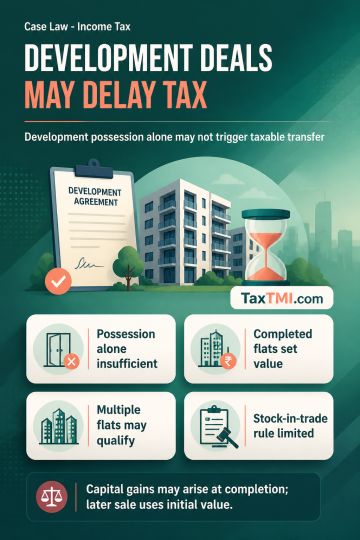
Joint development agreements defer taxable transfer where possession lacks part performance, while completed flats determine consideration and exempti...
The High Court addressed the challenge to notifications extending the time limit for issuance of orders u/s 73 of the CGST/AGST Act, 2017, due to the "force majeure" condition of Covid-19. The Court noted that amendments introduced by the Finance (No. 2) Act, 2024, retrospectively effective from 01.07.2017, allowed registered persons to claim input tax credit for financial years 2017-18 to 2020-21, subject to conditions prescribed in the newly inserted Sections 16(5) and 16(6) of the CGST Act, 2017. Consequently, the show-cause notice issued against the petitioners became redundant. The Court set aside the impugned order and remanded the matter to the competent jurisdictional officer for passing an appropriate order, disposing of the petition.
The High Court addressed the challenge to notifications extending the time limit for issuance of orders u/s 73 of the CGST/AGST Act, 2017, due to the "force majeure" condition of Covid-19. The Court noted that amendments introduced by the Finance (No. 2) Act, 2024, retrospectively effective from 01.07.2017, allowed registered persons to claim input tax credit for financial years 2017-18 to 2020-21, subject to conditions prescribed in the newly inserted Sections 16(5) and 16(6) of the CGST Act, 2017. Consequently, the show-cause notice issued against the petitioners became redundant. The Court set aside the impugned order and remanded the matter to the competent jurisdictional officer for passing an appropriate order, disposing of the petition.
Note: It is a system-generated summary and is for quick reference only.
 TaxTMI
 of 4803















 Join Channel


 TaxTMI
