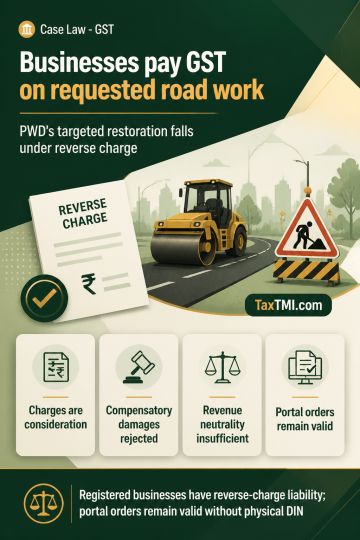
Request-driven road restoration attracts reverse-charge GST, not governmental-function treatment or compensatory-damages status for business recipient...
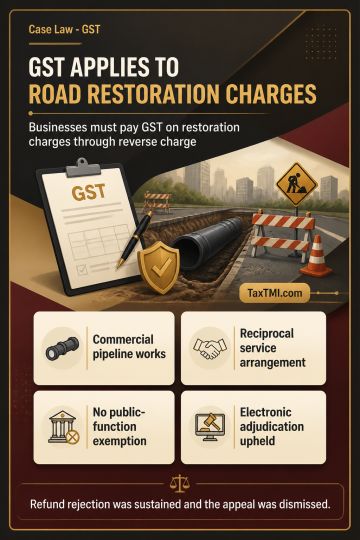
Road restoration charges for commercial pipeline works are taxable Government services, with reverse charge liability and no public-function exemption...
Model-wise import cap monitoring cannot justify withholding used multifunction machines where all-India tracking is absent and full security is furnis...
The High Court dismissed the petition challenging the show-cause notice dated 20.08.2024 issued by the respondent authority in relation to the refund of integrated taxes for the period FY 2018-19 to 2020-21. The court held that Rule 86(4B) of the CGST Rules, introduced vide Notification No. 14/2022-Central Tax dated 05.07.2022, allows recredit of input tax credit pertaining to the amount paid back for contravention of Rule 96 of the CGST Rules. The respondent authority initiated an independent investigation against the petitioner regarding the refund of integrated tax for the period in question, issuing the first show-cause notice on 03.04.2024. The court observed that there is a separate period of limitation of three years from the date of erroneous refund, and the Special Intelligence and Investigation Branch had started an investigation against the petitioner for the FY 2017-18 to 2020-2021 before issuing the show-cause notice after scrutinizing all documents. Therefore, the court found no reason to interfere with the impugned show-cause notice.
The High Court dismissed the petition challenging the show-cause notice dated 20.08.2024 issued by the respondent authority in relation to the refund of integrated taxes for the period FY 2018-19 to 2020-21. The court held that Rule 86(4B) of the CGST Rules, introduced vide Notification No. 14/2022-Central Tax dated 05.07.2022, allows recredit of input tax credit pertaining to the amount paid back for contravention of Rule 96 of the CGST Rules. The respondent authority initiated an independent investigation against the petitioner regarding the refund of integrated tax for the period in question, issuing the first show-cause notice on 03.04.2024. The court observed that there is a separate period of limitation of three years from the date of erroneous refund, and the Special Intelligence and Investigation Branch had started an investigation against the petitioner for the FY 2017-18 to 2020-2021 before issuing the show-cause notice after scrutinizing all documents. Therefore, the court found no reason to interfere with the impugned show-cause notice.
Note: It is a system-generated summary and is for quick reference only.
 TaxTMI
  TaxTMI
 of 4918