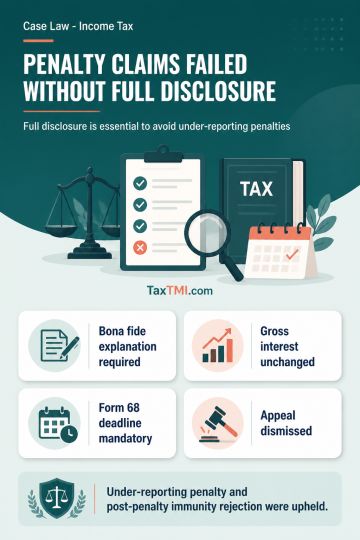
Bona fide disclosure requirements govern under-reporting penalties, and post-penalty immunity applications cannot secure available statutory protectio...
Certificate-of-origin verification procedure governs preferential customs benefits; denial without retroactive verification was set aside with consequ...
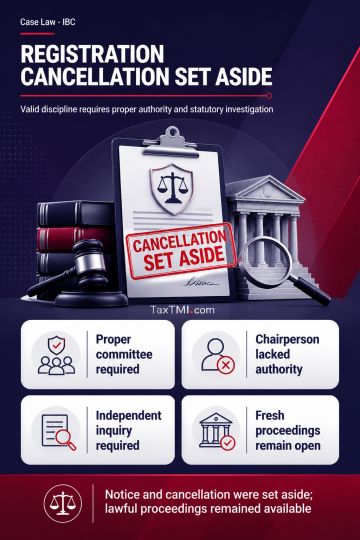
Disciplinary Committee jurisdiction and mandatory investigation requirements invalidated cancellation of an insolvency professional's registration and...
Retention of seized property survives where recorded reasons support proceeds of crime, while stayed investigation periods are excluded from limitatio...
Specified income of Baddi Barotiwala Nalagarh Development Authority receives conditional tax exemption, retrospectively covering its designated assess...
Page of 4805
Press 'Enter' after typing page number.
1221 to 1240 of 96092 Results
❮
❯
❯❯
0 / 200
Expand Note
Add to Folder
No Folders have been created
+
Are you sure you want to delete "My most important" ?
The High Court held that Section 17(2) of the CGST Act is not ultra vires Article 14 of the Constitution to the extent it restricts refund under the inverted duty structure. The petitioner does not have a vested right to claim refund of accumulated Input Tax Credit on goods and services due to the inverted duty structure under the first proviso to Section 54(3) of the CGST Act. The restrictions imposed on the petitioner on availing credits used for exempted services u/s 17(2) and claiming refund of taxes on inputs and input services under the first proviso to Section 54(3) are valid. The right to avail Input Tax Credit and the benefit of taxes paid on inputs and input services does not extend to exempted supplies. The petitioner, providing education services, falls under the category of fully exempt supply and is not entitled to Input Tax Credit refund. The legislature has rightly excluded supplies with Nil or exempted rate from the refund provision for the inverted rate structure u/s 54(3). As there is no constitutional or statutory entitlement to refund, the petitioner's claim for refund of ITC on exempt output services cannot be accepted. Consequently, the High Court dismissed the petition.
The High Court held that Section 17(2) of the CGST Act is not ultra vires Article 14 of the Constitution to the extent it restricts refund under the inverted duty structure. The petitioner does not have a vested right to claim refund of accumulated Input Tax Credit on goods and services due to the inverted duty structure under the first proviso to Section 54(3) of the CGST Act. The restrictions imposed on the petitioner on availing credits used for exempted services u/s 17(2) and claiming refund of taxes on inputs and input services under the first proviso to Section 54(3) are valid. The right to avail Input Tax Credit and the benefit of taxes paid on inputs and input services does not extend to exempted supplies. The petitioner, providing education services, falls under the category of fully exempt supply and is not entitled to Input Tax Credit refund. The legislature has rightly excluded supplies with Nil or exempted rate from the refund provision for the inverted rate structure u/s 54(3). As there is no constitutional or statutory entitlement to refund, the petitioner's claim for refund of ITC on exempt output services cannot be accepted. Consequently, the High Court dismissed the petition.
Note: It is a system-generated summary and is for quick reference only.
 TaxTMI
 of 4805











 Join Channel


 TaxTMI