Development agreements require legal possession or effective enjoyment for capital gains transfer; permissive possession and deferred consideration de...
Prolonged sterilisation of development rights supports capital-gains treatment, while business-income disallowances cannot govern capital-gains comput...
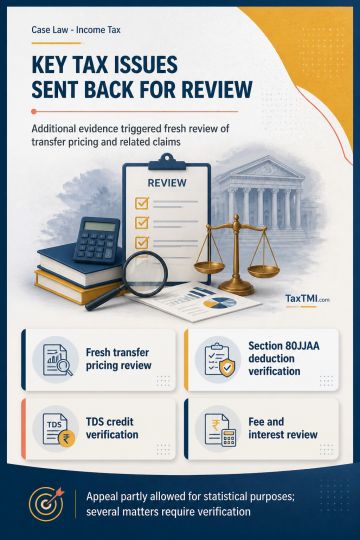
Additional evidence in transfer pricing dispute leads to fresh examination, while tax deductions, TDS credit, fee and refund interest require verifica...
Category II AIF pass-through taxation preserves non-business income character; investment receipts cannot be reclassified without applying recognised ...
The assessee was penalized u/s 271(1)(c) for addition of sale consideration due to lack of vouchers. The CIT(A) partly confirmed the addition for want of vouchers. The assessee argued that no penalty is maintainable as the transaction was truly disclosed, and long-term capital gains were reported. The ITAT held that the CIT(A) restricted the addition after examining the evidence, indicating the assessee succeeded partially. The AO imposed the penalty solely for non-submission of supporting vouchers. Relying on the CAFCO SYNDICATE SHIPPING CO. case, the ITAT ruled that penalty cannot be imposed for non-furnishing evidence as it does not amount to concealment of income. Consequently, the penalty levied by the AO was deleted, and the assessee's grounds were allowed.
The assessee was penalized u/s 271(1)(c) for addition of sale consideration due to lack of vouchers. The CIT(A) partly confirmed the addition for want of vouchers. The assessee argued that no penalty is maintainable as the transaction was truly disclosed, and long-term capital gains were reported. The ITAT held that the CIT(A) restricted the addition after examining the evidence, indicating the assessee succeeded partially. The AO imposed the penalty solely for non-submission of supporting vouchers. Relying on the CAFCO SYNDICATE SHIPPING CO. case, the ITAT ruled that penalty cannot be imposed for non-furnishing evidence as it does not amount to concealment of income. Consequently, the penalty levied by the AO was deleted, and the assessee's grounds were allowed.
Note: It is a system-generated summary and is for quick reference only.
 TaxTMI
 of 4805














 Join Channel


 TaxTMI
