Authentication of paper assessment orders upheld, while qualifying repairs, consumables and vendor advance write-offs remain deductible business claim...
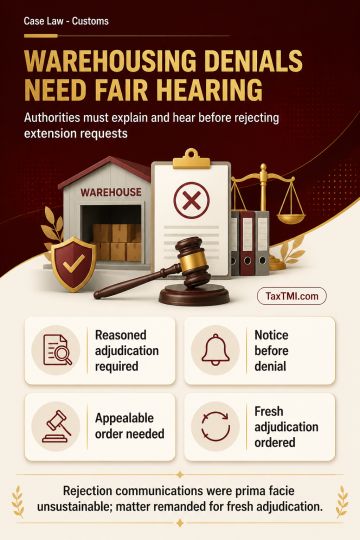
Transaction value cannot be rejected solely on non-statutory valuation guidelines without corroborative evidence supporting reassessment of final cust...
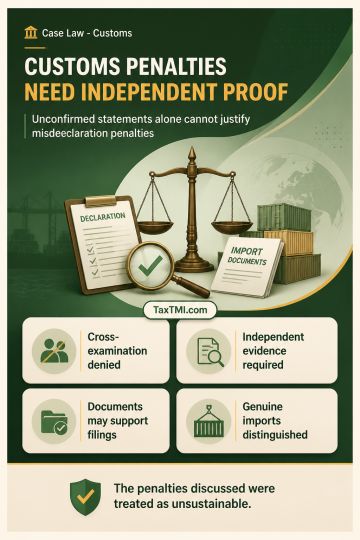
Cross-examination rights and corroborated evidence limit customs penalties for misdeclaration in genuine import transactions involving documented clea...
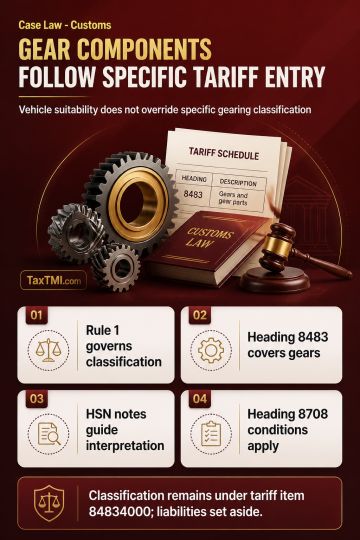
Tariff classification of vehicle gear components follows the specific gearing entry, displacing motor-vehicle parts classification and related liabili...
The assessee was penalized u/s 271(1)(c) for addition of sale consideration due to lack of vouchers. The CIT(A) partly confirmed the addition for want of vouchers. The assessee argued that no penalty is maintainable as the transaction was truly disclosed, and long-term capital gains were reported. The ITAT held that the CIT(A) restricted the addition after examining the evidence, indicating the assessee succeeded partially. The AO imposed the penalty solely for non-submission of supporting vouchers. Relying on the CAFCO SYNDICATE SHIPPING CO. case, the ITAT ruled that penalty cannot be imposed for non-furnishing evidence as it does not amount to concealment of income. Consequently, the penalty levied by the AO was deleted, and the assessee's grounds were allowed.
The assessee was penalized u/s 271(1)(c) for addition of sale consideration due to lack of vouchers. The CIT(A) partly confirmed the addition for want of vouchers. The assessee argued that no penalty is maintainable as the transaction was truly disclosed, and long-term capital gains were reported. The ITAT held that the CIT(A) restricted the addition after examining the evidence, indicating the assessee succeeded partially. The AO imposed the penalty solely for non-submission of supporting vouchers. Relying on the CAFCO SYNDICATE SHIPPING CO. case, the ITAT ruled that penalty cannot be imposed for non-furnishing evidence as it does not amount to concealment of income. Consequently, the penalty levied by the AO was deleted, and the assessee's grounds were allowed.
Note: It is a system-generated summary and is for quick reference only.
 TaxTMI
 of 4805















 Join Channel


 TaxTMI