Prolonged sterilisation of development rights supports capital-gains treatment, while business-income disallowances cannot govern capital-gains comput...
Additional evidence in transfer pricing dispute leads to fresh examination, while tax deductions, TDS credit, fee and refund interest require verifica...
Category II AIF pass-through taxation preserves non-business income character; investment receipts cannot be reclassified without applying recognised ...
Mutual fund maturity rules require proper rollover, redemption, disclosure, and due diligence; investor gains cannot excuse regulatory breaches or pen...
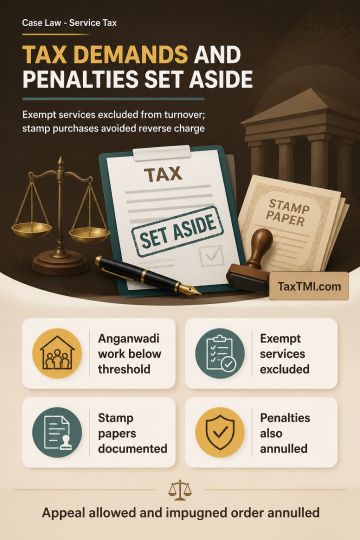
Threshold exemption excludes exempt services, while stamp-paper purchases avoid reverse charge; consequential service tax penalties were also set asid...
The High Court examined the validity of reassessment notices issued u/s 148 of the Income Tax Act by the Joint Assistant Commissioner (JAC) in light of the Faceless Assessment Scheme formulated u/s 151A. The key points are: The Act allows reassessment based on information from Risk Management System (RMS), audit objections, information from other countries, information u/s 135A schemes, or orders of Tribunals/Courts. The JAC can form an opinion based on such information and initiate reassessment proceedings u/s 148A. Information gathered during searches/surveys is also deemed as "information" for reassessment purposes under Explanation 2 to Section 148. The Faceless Assessment Scheme segregates the initiation of reassessment proceedings by the JAC from the actual faceless assessment by the National Faceless Assessment Centre (NFAC). The JAC examines information from RMS/other sources and forms an opinion on reassessment, while the NFAC conducts the actual faceless assessment through automated allocation. Rendering the JAC's powers redundant under the faceless scheme would conflict with beneficial construction principles and undermine provisions for comprehensive data analysis and informed decision-making. The High Court upheld the validity of notices issued by the JAC, observing a harmonious distribution of functions between the JAC and NF.
The High Court examined the validity of reassessment notices issued u/s 148 of the Income Tax Act by the Joint Assistant Commissioner (JAC) in light of the Faceless Assessment Scheme formulated u/s 151A. The key points are: The Act allows reassessment based on information from Risk Management System (RMS), audit objections, information from other countries, information u/s 135A schemes, or orders of Tribunals/Courts. The JAC can form an opinion based on such information and initiate reassessment proceedings u/s 148A. Information gathered during searches/surveys is also deemed as "information" for reassessment purposes under Explanation 2 to Section 148. The Faceless Assessment Scheme segregates the initiation of reassessment proceedings by the JAC from the actual faceless assessment by the National Faceless Assessment Centre (NFAC). The JAC examines information from RMS/other sources and forms an opinion on reassessment, while the NFAC conducts the actual faceless assessment through automated allocation. Rendering the JAC's powers redundant under the faceless scheme would conflict with beneficial construction principles and undermine provisions for comprehensive data analysis and informed decision-making. The High Court upheld the validity of notices issued by the JAC, observing a harmonious distribution of functions between the JAC and NF.
Note: It is a system-generated summary and is for quick reference only.
 TaxTMI
 of 4805


















 Join Channel


 TaxTMI
