Certificate-of-origin verification procedure governs preferential customs benefits; denial without retroactive verification was set aside with consequ...
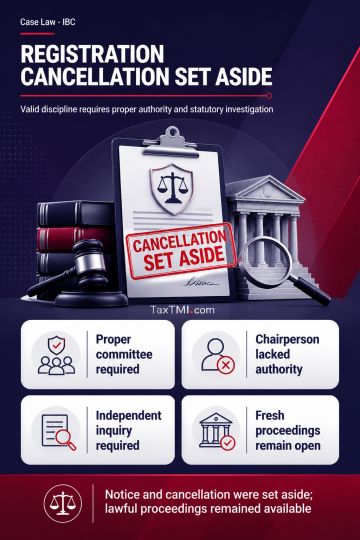
Disciplinary Committee jurisdiction and mandatory investigation requirements invalidated cancellation of an insolvency professional's registration and...
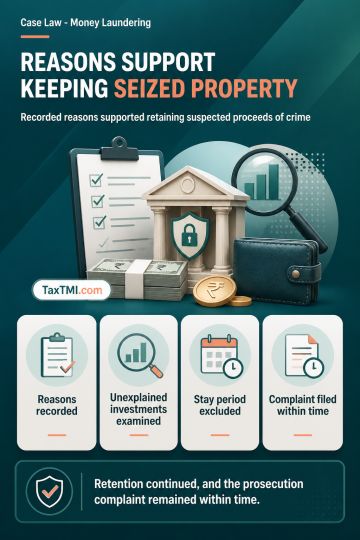
Retention of seized property survives where recorded reasons support proceeds of crime, while stayed investigation periods are excluded from limitatio...
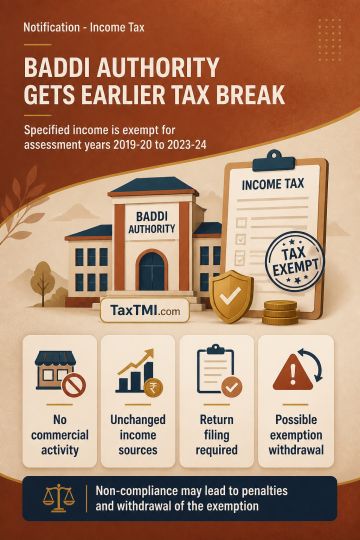
Specified income of Baddi Barotiwala Nalagarh Development Authority receives conditional tax exemption, retrospectively covering its designated assess...
Specified development authority income receives retrospective tax exemption, subject to non-commercial activity, unchanged income sources, and return-...
Unified Brand India framework introduces voluntary Trust Mark certification and funding support for export branding, packaging and global promotional ...
The High Court examined the validity of reassessment notices issued u/s 148 of the Income Tax Act by the Joint Assistant Commissioner (JAC) in light of the Faceless Assessment Scheme formulated u/s 151A. The key points are: The Act allows reassessment based on information from Risk Management System (RMS), audit objections, information from other countries, information u/s 135A schemes, or orders of Tribunals/Courts. The JAC can form an opinion based on such information and initiate reassessment proceedings u/s 148A. Information gathered during searches/surveys is also deemed as "information" for reassessment purposes under Explanation 2 to Section 148. The Faceless Assessment Scheme segregates the initiation of reassessment proceedings by the JAC from the actual faceless assessment by the National Faceless Assessment Centre (NFAC). The JAC examines information from RMS/other sources and forms an opinion on reassessment, while the NFAC conducts the actual faceless assessment through automated allocation. Rendering the JAC's powers redundant under the faceless scheme would conflict with beneficial construction principles and undermine provisions for comprehensive data analysis and informed decision-making. The High Court upheld the validity of notices issued by the JAC, observing a harmonious distribution of functions between the JAC and NF.
The High Court examined the validity of reassessment notices issued u/s 148 of the Income Tax Act by the Joint Assistant Commissioner (JAC) in light of the Faceless Assessment Scheme formulated u/s 151A. The key points are: The Act allows reassessment based on information from Risk Management System (RMS), audit objections, information from other countries, information u/s 135A schemes, or orders of Tribunals/Courts. The JAC can form an opinion based on such information and initiate reassessment proceedings u/s 148A. Information gathered during searches/surveys is also deemed as "information" for reassessment purposes under Explanation 2 to Section 148. The Faceless Assessment Scheme segregates the initiation of reassessment proceedings by the JAC from the actual faceless assessment by the National Faceless Assessment Centre (NFAC). The JAC examines information from RMS/other sources and forms an opinion on reassessment, while the NFAC conducts the actual faceless assessment through automated allocation. Rendering the JAC's powers redundant under the faceless scheme would conflict with beneficial construction principles and undermine provisions for comprehensive data analysis and informed decision-making. The High Court upheld the validity of notices issued by the JAC, observing a harmonious distribution of functions between the JAC and NF.
Note: It is a system-generated summary and is for quick reference only.
 TaxTMI
 of 4803













 Join Channel


 TaxTMI