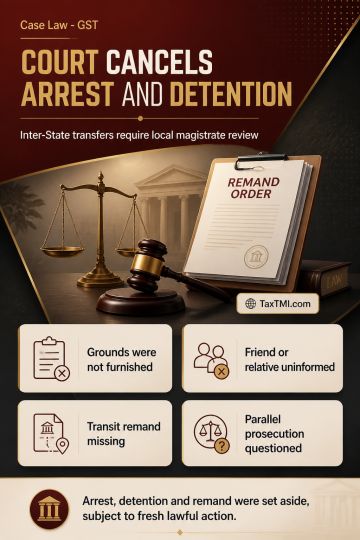
Administrative fraud classification suspension does not halt independent criminal investigation or warrant-based searches into alleged economic offenc...
Arrest safeguards and transit remand requirements invalidated detention following inter-State transfer without communicated grounds or magistrate auth...
Page of 4805
Press 'Enter' after typing page number.
821 to 840 of 96092 Results
❮
❯
❯❯
0 / 200
Expand Note
Add to Folder
No Folders have been created
+
Are you sure you want to delete "My most important" ?
The Income Tax Settlement Commission (ITSC) has wide powers under Chapter XIX-A to examine and evaluate all aspects of an application for settlement, including calling for reports, directing further inquiries, and holistically examining matters beyond the disclosures made by the applicant. The essential ingredients for granting immunity u/s 245H are cooperation by the applicant in computing total income and full and true disclosure of income, which are the same prerequisites for computation u/s 245D(4). Once the ITSC finds these conditions satisfied, its order granting immunity cannot be questioned separately, as both provisions are premised on identical considerations. The ITSC's order has finality u/s 245I, and can only be reviewed on grounds provided in Chapter XIX-A. Interfering with the grant of immunity would amount to questioning the acceptance of the application itself, which cannot be done if the statutory conditions were found satisfied. The principle of severability cannot be invoked as the considerations for computation and immunity are not distinct.
The Income Tax Settlement Commission (ITSC) has wide powers under Chapter XIX-A to examine and evaluate all aspects of an application for settlement, including calling for reports, directing further inquiries, and holistically examining matters beyond the disclosures made by the applicant. The essential ingredients for granting immunity u/s 245H are cooperation by the applicant in computing total income and full and true disclosure of income, which are the same prerequisites for computation u/s 245D(4). Once the ITSC finds these conditions satisfied, its order granting immunity cannot be questioned separately, as both provisions are premised on identical considerations. The ITSC's order has finality u/s 245I, and can only be reviewed on grounds provided in Chapter XIX-A. Interfering with the grant of immunity would amount to questioning the acceptance of the application itself, which cannot be done if the statutory conditions were found satisfied. The principle of severability cannot be invoked as the considerations for computation and immunity are not distinct.
Note: It is a system-generated summary and is for quick reference only.
 TaxTMI
 of 4805














 Join Channel


 TaxTMI