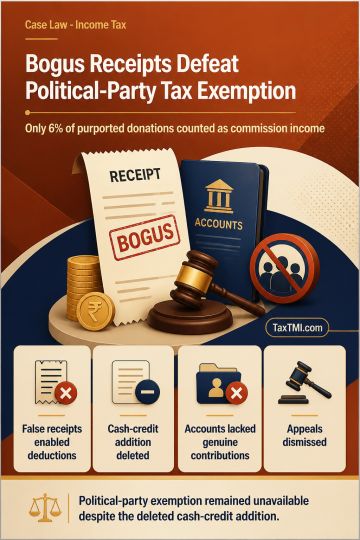
Bogus donation receipts justified commission income assessment and defeated political-party tax exemption for inaccurate accounts and reporting failur...
Pure reimbursement without income element escapes tax withholding, while delayed withholding and unsupported provisions face deferred or renewed scrut...
Public benefit requirement defeats charitable registration where residents' association services are reciprocal, member-only facilities governed by mu...
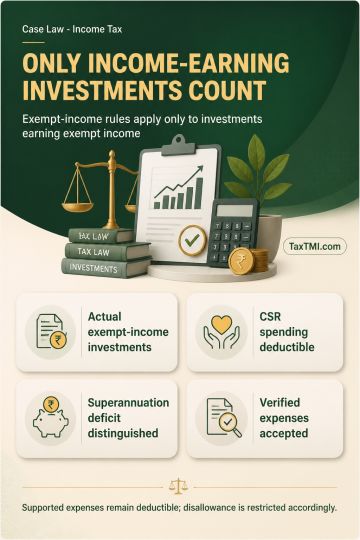
Exempt-income expenditure disallowance is confined to investments that actually generated exempt income, while supported business expenses remain dedu...
Objective characteristics and principal use govern mining-tyre classification, while fresh advance ruling applications may rely on additional technica...
Page of 4805
Press 'Enter' after typing page number.
801 to 820 of 96092 Results
❮
❯
❯❯
0 / 200
Expand Note
Add to Folder
No Folders have been created
+
Are you sure you want to delete "My most important" ?
The Income Tax Settlement Commission (ITSC) has wide powers under Chapter XIX-A to examine and evaluate all aspects of an application for settlement, including calling for reports, directing further inquiries, and holistically examining matters beyond the disclosures made by the applicant. The essential ingredients for granting immunity u/s 245H are cooperation by the applicant in computing total income and full and true disclosure of income, which are the same prerequisites for computation u/s 245D(4). Once the ITSC finds these conditions satisfied, its order granting immunity cannot be questioned separately, as both provisions are premised on identical considerations. The ITSC's order has finality u/s 245I, and can only be reviewed on grounds provided in Chapter XIX-A. Interfering with the grant of immunity would amount to questioning the acceptance of the application itself, which cannot be done if the statutory conditions were found satisfied. The principle of severability cannot be invoked as the considerations for computation and immunity are not distinct.
The Income Tax Settlement Commission (ITSC) has wide powers under Chapter XIX-A to examine and evaluate all aspects of an application for settlement, including calling for reports, directing further inquiries, and holistically examining matters beyond the disclosures made by the applicant. The essential ingredients for granting immunity u/s 245H are cooperation by the applicant in computing total income and full and true disclosure of income, which are the same prerequisites for computation u/s 245D(4). Once the ITSC finds these conditions satisfied, its order granting immunity cannot be questioned separately, as both provisions are premised on identical considerations. The ITSC's order has finality u/s 245I, and can only be reviewed on grounds provided in Chapter XIX-A. Interfering with the grant of immunity would amount to questioning the acceptance of the application itself, which cannot be done if the statutory conditions were found satisfied. The principle of severability cannot be invoked as the considerations for computation and immunity are not distinct.
Note: It is a system-generated summary and is for quick reference only.
 TaxTMI
 of 4805











 Join Channel


 TaxTMI