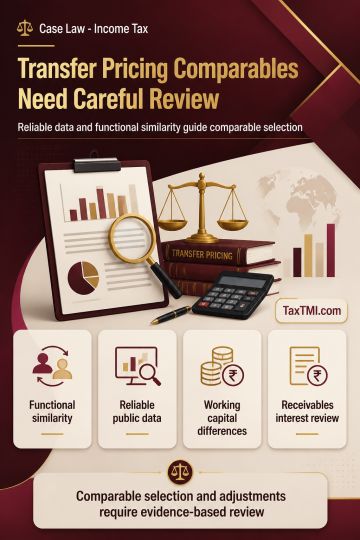
Transfer pricing comparability requires functional alignment, reliable financial data, and careful review of working capital and receivables adjustmen...
Transfer pricing rules require benchmarking corporate guarantees and associated-enterprise advances, while invalid domestic-transaction adjustments ca...
Prospective sugar export prohibition required registered letters of credit; private contracts and export quotas created no enforceable continuation ri...
Retroactive interim-moratorium exclusion permits protective asset disclosure and preservation measures against personal guarantors pending arbitration...
Page of 4798
Press 'Enter' after typing page number.
461 to 480 of 95957 Results
❮
❯
❯❯
0 / 200
Expand Note
Add to Folder
No Folders have been created
+
Are you sure you want to delete "My most important" ?
Applicability of Section 64(1) and Section 54F of the Income Tax Act. Section 64(1) allows for the inclusion of a dependent spouse's income in the assessee's taxable income. The Tribunal held that the assessee's wife was dependent, and her income was rightly included in the assessee's return u/s 64(1). Regarding Section 54F, which provides exemption from long-term capital gains on the sale of a residential property if the proceeds are invested in another residential property, the Tribunal held that the investment in two adjacent flats by the assessee's wife qualified as a single residential unit. Therefore, the assessee was eligible for the exemption u/s 54F, despite the amendment restricting it to one residential unit from April 1, 2015. The Tribunal relied on previous judicial precedents and allowed the assessee's appeal.
Applicability of Section 64(1) and Section 54F of the Income Tax Act. Section 64(1) allows for the inclusion of a dependent spouse's income in the assessee's taxable income. The Tribunal held that the assessee's wife was dependent, and her income was rightly included in the assessee's return u/s 64(1). Regarding Section 54F, which provides exemption from long-term capital gains on the sale of a residential property if the proceeds are invested in another residential property, the Tribunal held that the investment in two adjacent flats by the assessee's wife qualified as a single residential unit. Therefore, the assessee was eligible for the exemption u/s 54F, despite the amendment restricting it to one residential unit from April 1, 2015. The Tribunal relied on previous judicial precedents and allowed the assessee's appeal.
Note: It is a system-generated summary and is for quick reference only.
 TaxTMI
 of 4798
















 Join Channel


 TaxTMI