Inherited property sale proceeds require capital-gains treatment where ownership is supported by evidence, not suspicion or unverified signature doubt...
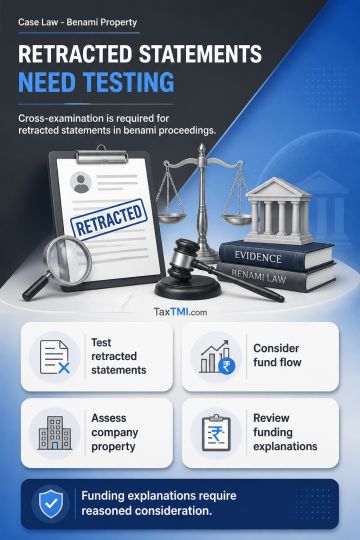
Cross-examination of retracted statements is essential where foundational evidence supports a benami allegation and documented funding explanations re...
Capital-goods exemption covers plant-modernisation accessories, while the import restriction applies only to earlier capital-goods components and spar...
Constitutional judicial review permits challenges to ECIRs and connected money-laundering proceedings where coercive action affects fundamental intere...
The appellant undertook several activities on bought-out items, raising the issue of whether these processes amounted to manufacture liable for excise duty. For certain finished products like "EOLIA SHOWER ONLY TRIM", the activities performed transformed individual parts into a complete product with a distinct identity, end-use, and nomenclature, amounting to manufacture u/s 2(f) of the Central Excise Act, 1944. Regarding items like "BOTTLE TRAP" and "FLOOR DRAIN", the appellant claimed the Physical Vapor Deposition (PVD) process merely changed color and made products rust-free, not constituting manufacture. However, applying the Supreme Court's ratio in UNION OF INDIA VERSUS JG. GLASS INDUSTRIES LTD., the PVD process was found essential for product usability by preventing corrosion, qualifying as manufacture incidental to finished goods production u/s 2(f). Consequently, the appeal was partly allowed and partly dismissed by the Appellate Tribunal.
The appellant undertook several activities on bought-out items, raising the issue of whether these processes amounted to manufacture liable for excise duty. For certain finished products like "EOLIA SHOWER ONLY TRIM", the activities performed transformed individual parts into a complete product with a distinct identity, end-use, and nomenclature, amounting to manufacture u/s 2(f) of the Central Excise Act, 1944. Regarding items like "BOTTLE TRAP" and "FLOOR DRAIN", the appellant claimed the Physical Vapor Deposition (PVD) process merely changed color and made products rust-free, not constituting manufacture. However, applying the Supreme Court's ratio in UNION OF INDIA VERSUS JG. GLASS INDUSTRIES LTD., the PVD process was found essential for product usability by preventing corrosion, qualifying as manufacture incidental to finished goods production u/s 2(f). Consequently, the appeal was partly allowed and partly dismissed by the Appellate Tribunal.
Note: It is a system-generated summary and is for quick reference only.
 TaxTMI
 of 4784



















 Join Channel


 TaxTMI