Cooperative society deposits, member-interest TDS exemption and credit-facility deduction claims require verification through records and supporting e...
Customs jurisdiction over EPCG condition breaches survives export-obligation discharge certificates, requiring alleged fraud and misdeclaration to be ...
Contractual tolerance requires consideration; breach recoveries, qualifying public infrastructure services and road works escape service tax liability...
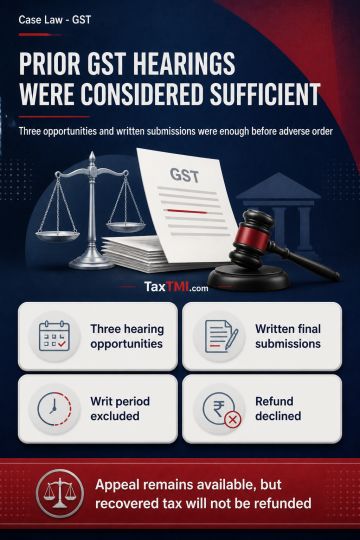
Personal hearing requirements in GST adjudication were satisfied by prior opportunities and written submissions; appellate limitation received writ-pe...
The appellant undertook several activities on bought-out items, raising the issue of whether these processes amounted to manufacture liable for excise duty. For certain finished products like "EOLIA SHOWER ONLY TRIM", the activities performed transformed individual parts into a complete product with a distinct identity, end-use, and nomenclature, amounting to manufacture u/s 2(f) of the Central Excise Act, 1944. Regarding items like "BOTTLE TRAP" and "FLOOR DRAIN", the appellant claimed the Physical Vapor Deposition (PVD) process merely changed color and made products rust-free, not constituting manufacture. However, applying the Supreme Court's ratio in UNION OF INDIA VERSUS JG. GLASS INDUSTRIES LTD., the PVD process was found essential for product usability by preventing corrosion, qualifying as manufacture incidental to finished goods production u/s 2(f). Consequently, the appeal was partly allowed and partly dismissed by the Appellate Tribunal.
The appellant undertook several activities on bought-out items, raising the issue of whether these processes amounted to manufacture liable for excise duty. For certain finished products like "EOLIA SHOWER ONLY TRIM", the activities performed transformed individual parts into a complete product with a distinct identity, end-use, and nomenclature, amounting to manufacture u/s 2(f) of the Central Excise Act, 1944. Regarding items like "BOTTLE TRAP" and "FLOOR DRAIN", the appellant claimed the Physical Vapor Deposition (PVD) process merely changed color and made products rust-free, not constituting manufacture. However, applying the Supreme Court's ratio in UNION OF INDIA VERSUS JG. GLASS INDUSTRIES LTD., the PVD process was found essential for product usability by preventing corrosion, qualifying as manufacture incidental to finished goods production u/s 2(f). Consequently, the appeal was partly allowed and partly dismissed by the Appellate Tribunal.
Note: It is a system-generated summary and is for quick reference only.
 TaxTMI
 of 4792

















 Join Channel


 TaxTMI