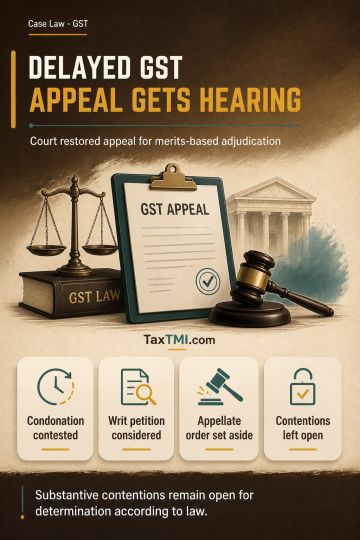
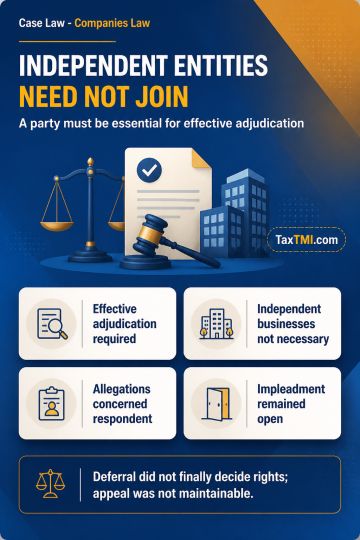
Necessary-party requirements limit impleadment of independent entities, while deferred consideration does not create an appealable adverse determinati...
Food supplement classification requires common parlance and authoritative tests, preventing treatment as proprietary Ayurvedic medicines without suppo...
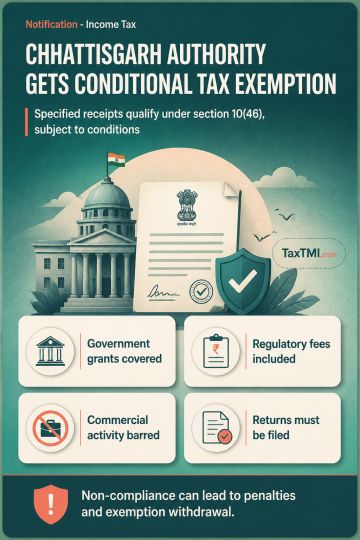
Specified regulatory authority income receives conditional tax exemption, subject to non-commercial activity, unchanged income character, and return f...
Tax exemption for regulatory authority income applies retrospectively, subject to non-commercial activity, unchanged income sources, and return-filing...
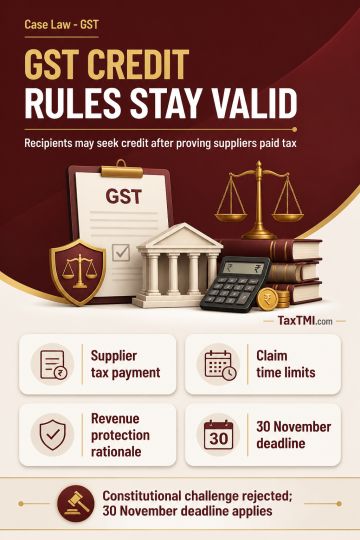
Input tax credit conditions remain constitutionally valid, with eligible recipient claims considered under GST circulars and retrospective filing dead...
The appellant undertook several activities on bought-out items, raising the issue of whether these processes amounted to manufacture liable for excise duty. For certain finished products like "EOLIA SHOWER ONLY TRIM", the activities performed transformed individual parts into a complete product with a distinct identity, end-use, and nomenclature, amounting to manufacture u/s 2(f) of the Central Excise Act, 1944. Regarding items like "BOTTLE TRAP" and "FLOOR DRAIN", the appellant claimed the Physical Vapor Deposition (PVD) process merely changed color and made products rust-free, not constituting manufacture. However, applying the Supreme Court's ratio in UNION OF INDIA VERSUS JG. GLASS INDUSTRIES LTD., the PVD process was found essential for product usability by preventing corrosion, qualifying as manufacture incidental to finished goods production u/s 2(f). Consequently, the appeal was partly allowed and partly dismissed by the Appellate Tribunal.
The appellant undertook several activities on bought-out items, raising the issue of whether these processes amounted to manufacture liable for excise duty. For certain finished products like "EOLIA SHOWER ONLY TRIM", the activities performed transformed individual parts into a complete product with a distinct identity, end-use, and nomenclature, amounting to manufacture u/s 2(f) of the Central Excise Act, 1944. Regarding items like "BOTTLE TRAP" and "FLOOR DRAIN", the appellant claimed the Physical Vapor Deposition (PVD) process merely changed color and made products rust-free, not constituting manufacture. However, applying the Supreme Court's ratio in UNION OF INDIA VERSUS JG. GLASS INDUSTRIES LTD., the PVD process was found essential for product usability by preventing corrosion, qualifying as manufacture incidental to finished goods production u/s 2(f). Consequently, the appeal was partly allowed and partly dismissed by the Appellate Tribunal.
Note: It is a system-generated summary and is for quick reference only.
 TaxTMI
 of 4792










 Join Channel


 TaxTMI