Tax exemption for regulatory authority income applies retrospectively, subject to non-commercial activity, unchanged income sources, and return filing...
Dispute Resolution Panel objections must reach both prescribed forums; otherwise assessment may proceed and statutory appeal remains the proper remedy...
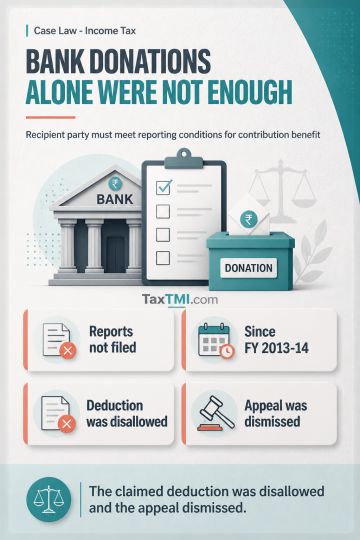
Political contribution deductions require recipient party compliance with contribution-reporting conditions; banking-channel donations alone do not qu...
Aggregation under TNMM prevents selective testing of intra-group services without comparable uncontrolled transactions, while appellate additional cla...
Page of 4790
Press 'Enter' after typing page number.
421 to 440 of 95794 Results
❮
❯
❯❯
0 / 200
Expand Note
Add to Folder
No Folders have been created
+
Are you sure you want to delete "My most important" ?
The appellant undertook several activities on bought-out items, raising the issue of whether these processes amounted to manufacture liable for excise duty. For certain finished products like "EOLIA SHOWER ONLY TRIM", the activities performed transformed individual parts into a complete product with a distinct identity, end-use, and nomenclature, amounting to manufacture u/s 2(f) of the Central Excise Act, 1944. Regarding items like "BOTTLE TRAP" and "FLOOR DRAIN", the appellant claimed the Physical Vapor Deposition (PVD) process merely changed color and made products rust-free, not constituting manufacture. However, applying the Supreme Court's ratio in UNION OF INDIA VERSUS JG. GLASS INDUSTRIES LTD., the PVD process was found essential for product usability by preventing corrosion, qualifying as manufacture incidental to finished goods production u/s 2(f). Consequently, the appeal was partly allowed and partly dismissed by the Appellate Tribunal.
The appellant undertook several activities on bought-out items, raising the issue of whether these processes amounted to manufacture liable for excise duty. For certain finished products like "EOLIA SHOWER ONLY TRIM", the activities performed transformed individual parts into a complete product with a distinct identity, end-use, and nomenclature, amounting to manufacture u/s 2(f) of the Central Excise Act, 1944. Regarding items like "BOTTLE TRAP" and "FLOOR DRAIN", the appellant claimed the Physical Vapor Deposition (PVD) process merely changed color and made products rust-free, not constituting manufacture. However, applying the Supreme Court's ratio in UNION OF INDIA VERSUS JG. GLASS INDUSTRIES LTD., the PVD process was found essential for product usability by preventing corrosion, qualifying as manufacture incidental to finished goods production u/s 2(f). Consequently, the appeal was partly allowed and partly dismissed by the Appellate Tribunal.
Note: It is a system-generated summary and is for quick reference only.
 TaxTMI
 of 4790












 Join Channel


 TaxTMI

