Additional evidence in transfer pricing dispute leads to fresh examination, while tax deductions, TDS credit, fee and refund interest require verifica...
Category II AIF pass-through taxation preserves non-business income character; investment receipts cannot be reclassified without applying recognised ...
Mutual fund maturity rules require proper rollover, redemption, disclosure, and due diligence; investor gains cannot excuse regulatory breaches or pen...
Threshold exemption excludes exempt services, while stamp-paper purchases avoid reverse charge; consequential service tax penalties were also set asid...
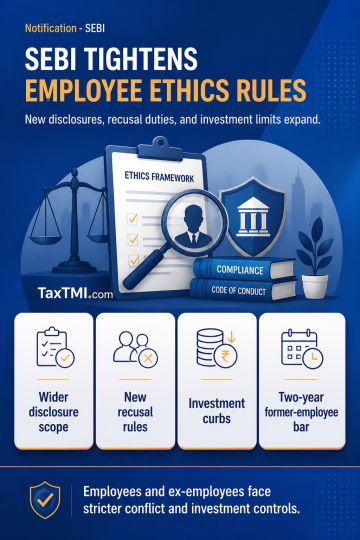
Employee conflict disclosures and investment restrictions expand with new recusal duties, post-employment limits, and compliance reporting requirement...
Reversal of CENVAT credit u/r 6(3A)(c)(iii) of the CENVAT Credit Rules, 2004. It clarifies that the term 'total CENVAT credit taken' used in the provision is unambiguous and should be interpreted as 'common input services taken' during the financial year, not the total CENVAT credit. The court held that the distortion in the old Rules was cured to ensure manufacturers/service providers do not pay reverse/pay excess amounts u/r 6(3A)(c)(ii). The trading activities carried out were considered "exempted service" within the CENVAT Credit Rules, 2004, both before and after the amendment. The relevant provisions, Rules 2(e) and 6, underwent changes, addressing the distortion arising from strict application of the old format. The impugned order was set aside, and the appeal was allowed, entitling the appellant to consequential relief, if any.
Reversal of CENVAT credit u/r 6(3A)(c)(iii) of the CENVAT Credit Rules, 2004. It clarifies that the term 'total CENVAT credit taken' used in the provision is unambiguous and should be interpreted as 'common input services taken' during the financial year, not the total CENVAT credit. The court held that the distortion in the old Rules was cured to ensure manufacturers/service providers do not pay reverse/pay excess amounts u/r 6(3A)(c)(ii). The trading activities carried out were considered "exempted service" within the CENVAT Credit Rules, 2004, both before and after the amendment. The relevant provisions, Rules 2(e) and 6, underwent changes, addressing the distortion arising from strict application of the old format. The impugned order was set aside, and the appeal was allowed, entitling the appellant to consequential relief, if any.
Note: It is a system-generated summary and is for quick reference only.
 TaxTMI
 of 4803



















 Join Channel


 TaxTMI
