Transfer pricing and tax deductions upheld on established principles, while employee contributions and warranty provisions returned for fresh examinat...
Captive transfer pricing relies on industrial consumer tariffs, while genuine quotations can benchmark effluent treatment transfers under the Other Me...
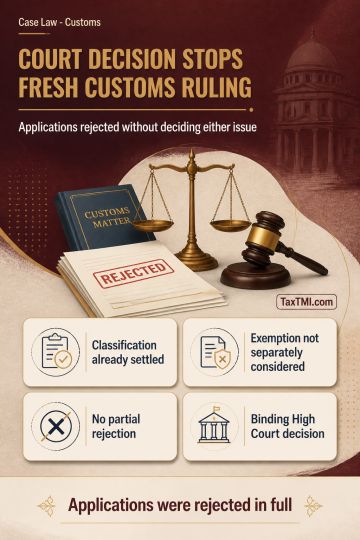
Specific tariff classification for ophthalmic instruments and extended limitation principles determine the treatment of duty demands, confiscation, an...
Integrated golf function determines classification, placing launch monitors and simulators under other golf equipment rather than measuring instrument...
Public servant status under anti-corruption law extends to recognised stock exchange leadership; constitutional and sanction challenges do not succeed...
Acquiescence, homebuyer protection and clean-slate resolution principles prevent landowners from disrupting an integrated project through late termina...
Reversal of CENVAT credit u/r 6(3A)(c)(iii) of the CENVAT Credit Rules, 2004. It clarifies that the term 'total CENVAT credit taken' used in the provision is unambiguous and should be interpreted as 'common input services taken' during the financial year, not the total CENVAT credit. The court held that the distortion in the old Rules was cured to ensure manufacturers/service providers do not pay reverse/pay excess amounts u/r 6(3A)(c)(ii). The trading activities carried out were considered "exempted service" within the CENVAT Credit Rules, 2004, both before and after the amendment. The relevant provisions, Rules 2(e) and 6, underwent changes, addressing the distortion arising from strict application of the old format. The impugned order was set aside, and the appeal was allowed, entitling the appellant to consequential relief, if any.
Reversal of CENVAT credit u/r 6(3A)(c)(iii) of the CENVAT Credit Rules, 2004. It clarifies that the term 'total CENVAT credit taken' used in the provision is unambiguous and should be interpreted as 'common input services taken' during the financial year, not the total CENVAT credit. The court held that the distortion in the old Rules was cured to ensure manufacturers/service providers do not pay reverse/pay excess amounts u/r 6(3A)(c)(ii). The trading activities carried out were considered "exempted service" within the CENVAT Credit Rules, 2004, both before and after the amendment. The relevant provisions, Rules 2(e) and 6, underwent changes, addressing the distortion arising from strict application of the old format. The impugned order was set aside, and the appeal was allowed, entitling the appellant to consequential relief, if any.
Note: It is a system-generated summary and is for quick reference only.
 TaxTMI
 of 4803















 Join Channel


 TaxTMI