Origin Declaration authentication governs preferential tariff claims under India-UK CETA, requiring a validated reference number before import clearan...
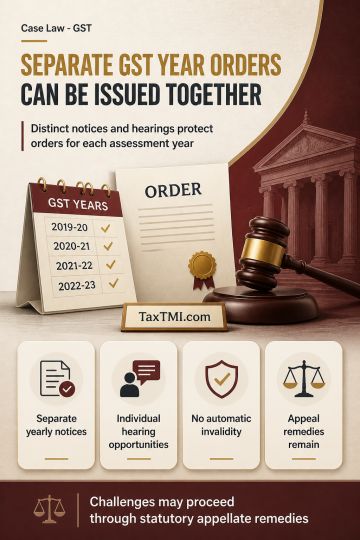
Separate assessment orders for different years remain valid when distinct notices and hearing opportunities prevent prejudice from combined proceeding...
Defined public benefit can retain charitable character; registration renewal requires examining genuine activities and legal compliance, not surplus a...
Capital reduction is distinct from share buy-back, preventing buy-back tax; restructuring interest and related business deductions also survive scruti...
Reversal of CENVAT credit u/r 6(3A)(c)(iii) of the CENVAT Credit Rules, 2004. It clarifies that the term 'total CENVAT credit taken' used in the provision is unambiguous and should be interpreted as 'common input services taken' during the financial year, not the total CENVAT credit. The court held that the distortion in the old Rules was cured to ensure manufacturers/service providers do not pay reverse/pay excess amounts u/r 6(3A)(c)(ii). The trading activities carried out were considered "exempted service" within the CENVAT Credit Rules, 2004, both before and after the amendment. The relevant provisions, Rules 2(e) and 6, underwent changes, addressing the distortion arising from strict application of the old format. The impugned order was set aside, and the appeal was allowed, entitling the appellant to consequential relief, if any.
Reversal of CENVAT credit u/r 6(3A)(c)(iii) of the CENVAT Credit Rules, 2004. It clarifies that the term 'total CENVAT credit taken' used in the provision is unambiguous and should be interpreted as 'common input services taken' during the financial year, not the total CENVAT credit. The court held that the distortion in the old Rules was cured to ensure manufacturers/service providers do not pay reverse/pay excess amounts u/r 6(3A)(c)(ii). The trading activities carried out were considered "exempted service" within the CENVAT Credit Rules, 2004, both before and after the amendment. The relevant provisions, Rules 2(e) and 6, underwent changes, addressing the distortion arising from strict application of the old format. The impugned order was set aside, and the appeal was allowed, entitling the appellant to consequential relief, if any.
Note: It is a system-generated summary and is for quick reference only.
 TaxTMI
 of 4803



















 Join Channel


 TaxTMI
