Specialized Investment Fund distribution now requires dedicated certification, while transitional recognition preserves existing qualified distributor...
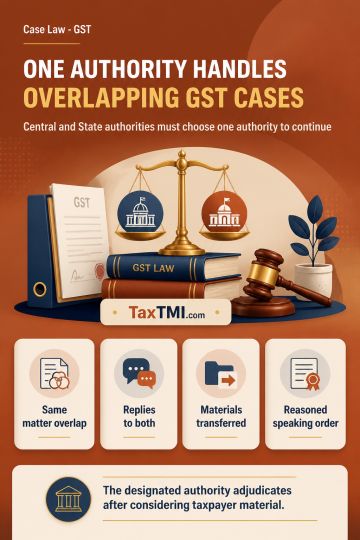
Overlapping GST proceedings require Central and State authorities to designate one competent authority for coordinated adjudication of the same matter...
Composite healthcare supplies retain exemption when patient care is the contract's essential character, despite payment through an implementing agency...
Page of 4801
Press 'Enter' after typing page number.
921 to 940 of 96001 Results
❮
❯
❯❯
0 / 200
Expand Note
Add to Folder
No Folders have been created
+
Are you sure you want to delete "My most important" ?
Reversal of CENVAT credit u/r 6(3A)(c)(iii) of the CENVAT Credit Rules, 2004. It clarifies that the term 'total CENVAT credit taken' used in the provision is unambiguous and should be interpreted as 'common input services taken' during the financial year, not the total CENVAT credit. The court held that the distortion in the old Rules was cured to ensure manufacturers/service providers do not pay reverse/pay excess amounts u/r 6(3A)(c)(ii). The trading activities carried out were considered "exempted service" within the CENVAT Credit Rules, 2004, both before and after the amendment. The relevant provisions, Rules 2(e) and 6, underwent changes, addressing the distortion arising from strict application of the old format. The impugned order was set aside, and the appeal was allowed, entitling the appellant to consequential relief, if any.
Reversal of CENVAT credit u/r 6(3A)(c)(iii) of the CENVAT Credit Rules, 2004. It clarifies that the term 'total CENVAT credit taken' used in the provision is unambiguous and should be interpreted as 'common input services taken' during the financial year, not the total CENVAT credit. The court held that the distortion in the old Rules was cured to ensure manufacturers/service providers do not pay reverse/pay excess amounts u/r 6(3A)(c)(ii). The trading activities carried out were considered "exempted service" within the CENVAT Credit Rules, 2004, both before and after the amendment. The relevant provisions, Rules 2(e) and 6, underwent changes, addressing the distortion arising from strict application of the old format. The impugned order was set aside, and the appeal was allowed, entitling the appellant to consequential relief, if any.
Note: It is a system-generated summary and is for quick reference only.
 TaxTMI
 of 4801













 Join Channel


 TaxTMI