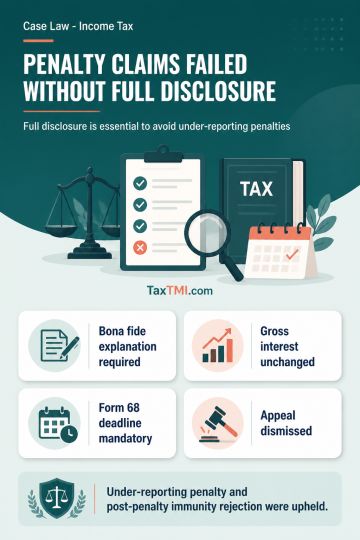
Bona fide disclosure requirements govern under-reporting penalties, and post-penalty immunity applications cannot secure available statutory protectio...
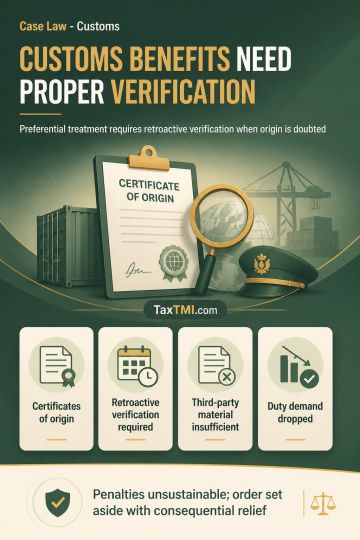
Certificate-of-origin verification procedure governs preferential customs benefits; denial without retroactive verification was set aside with consequ...
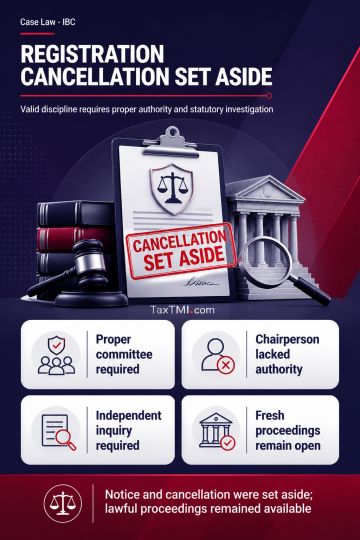
Disciplinary Committee jurisdiction and mandatory investigation requirements invalidated cancellation of an insolvency professional's registration and...
Retention of seized property survives where recorded reasons support proceeds of crime, while stayed investigation periods are excluded from limitatio...
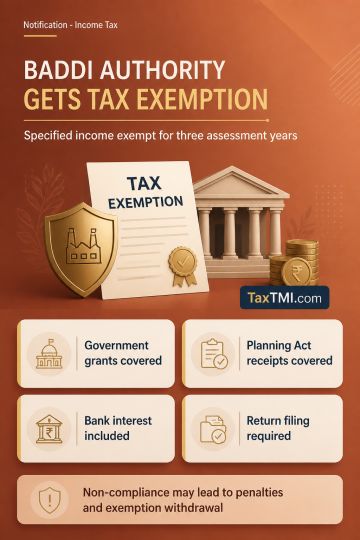
Specified income of Baddi Barotiwala Nalagarh Development Authority receives conditional tax exemption, retrospectively covering its designated assess...
Page of 4805
Press 'Enter' after typing page number.
1221 to 1240 of 96092 Results
❮
❯
❯❯
0 / 200
Expand Note
Add to Folder
No Folders have been created
+
Are you sure you want to delete "My most important" ?
The High Court addressed the issue of cancellation of GST registration due to non-filing of returns and the rejection of an appeal on the ground of time limitation. The respondent claimed that the statute prescribes a specific limitation period of 90 days to file an appeal, and the petitioner's appeal was time-barred. The Court held that no useful purpose would be served by keeping the petitioners out of the Goods and Service Tax regime, as they would continue their businesses and supply goods and services. The Court acknowledged that most small-scale entrepreneurs are uneducated and unaccustomed to handling emails and advanced technologies, despite providing email IDs during registration. The Court emphasized that the object of any government should be to promote trade, not curtail it. The method adopted by the department is likened to strangulating the neck of small-scale entrepreneurs, as cancellation of registration amounts to capital punishment for traders. The Court expects the GST department to amend relevant provisions, considering the consequences on traders, and to find modalities for conveying show cause notices via SMS and regional languages.
The High Court addressed the issue of cancellation of GST registration due to non-filing of returns and the rejection of an appeal on the ground of time limitation. The respondent claimed that the statute prescribes a specific limitation period of 90 days to file an appeal, and the petitioner's appeal was time-barred. The Court held that no useful purpose would be served by keeping the petitioners out of the Goods and Service Tax regime, as they would continue their businesses and supply goods and services. The Court acknowledged that most small-scale entrepreneurs are uneducated and unaccustomed to handling emails and advanced technologies, despite providing email IDs during registration. The Court emphasized that the object of any government should be to promote trade, not curtail it. The method adopted by the department is likened to strangulating the neck of small-scale entrepreneurs, as cancellation of registration amounts to capital punishment for traders. The Court expects the GST department to amend relevant provisions, considering the consequences on traders, and to find modalities for conveying show cause notices via SMS and regional languages.
Note: It is a system-generated summary and is for quick reference only.
 TaxTMI
 of 4805














 Join Channel


 TaxTMI