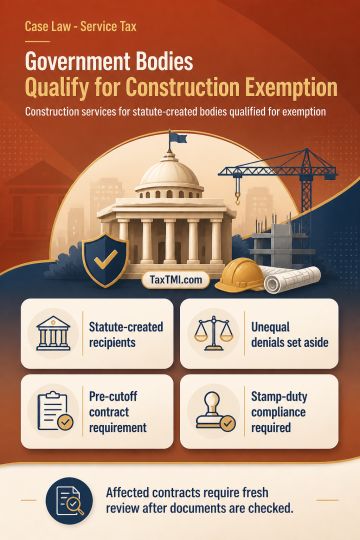
Governmental authority status supports construction-service exemption, while pre-cutoff contract and stamp-duty compliance requires verification on re...
Automated Free Sale and Commerce Certificates enable paperless processing while retaining risk-based manual verification for selected exporter applica...
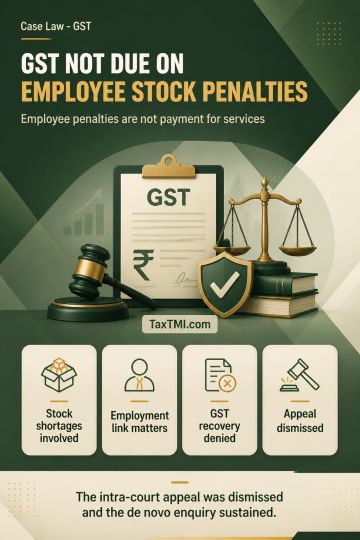
Employee stock-shortage penalties do not constitute consideration for services, preventing GST collection under Schedule II in employment relationship...
The assessee, a university, claimed exemption u/s 10(23C)(iiiab) for the relevant assessment year, which was accepted by the Assessing Officer (AO) after considering the applicable laws and facts. The AO included interest income on government grants in calculating the government financing, which exceeded 50% of the total income, meeting the substantial financing threshold. The Commissioner of Income Tax (Appeals) [CIT(E)] invoked Section 263, revising the AO's order as prejudicial to revenue, by excluding interest income and applying Rule 2BBB retrospectively. The Appellate Tribunal held that the AO correctly allowed the exemption based on the prevailing legal framework, judicial precedents, and facts. The exclusion of interest income and retrospective application of Rule 2BBB by the CIT(E) were incorrect. The AO's order was neither erroneous nor prejudicial to revenue. Accordingly, the CIT(E)'s order invoking Section 263 was quashed, and the assessee's appeal was allowed, upholding the principle of consistency and the AO's decision to grant exemption u/s 10(23C)(iiiab).
The assessee, a university, claimed exemption u/s 10(23C)(iiiab) for the relevant assessment year, which was accepted by the Assessing Officer (AO) after considering the applicable laws and facts. The AO included interest income on government grants in calculating the government financing, which exceeded 50% of the total income, meeting the substantial financing threshold. The Commissioner of Income Tax (Appeals) [CIT(E)] invoked Section 263, revising the AO's order as prejudicial to revenue, by excluding interest income and applying Rule 2BBB retrospectively. The Appellate Tribunal held that the AO correctly allowed the exemption based on the prevailing legal framework, judicial precedents, and facts. The exclusion of interest income and retrospective application of Rule 2BBB by the CIT(E) were incorrect. The AO's order was neither erroneous nor prejudicial to revenue. Accordingly, the CIT(E)'s order invoking Section 263 was quashed, and the assessee's appeal was allowed, upholding the principle of consistency and the AO's decision to grant exemption u/s 10(23C)(iiiab).
Note: It is a system-generated summary and is for quick reference only.
 TaxTMI
  TaxTMI
 of 4828









 Join Channel


