Transaction value cannot be rejected solely on non-statutory valuation guidelines without corroborative evidence supporting reassessment of final cust...
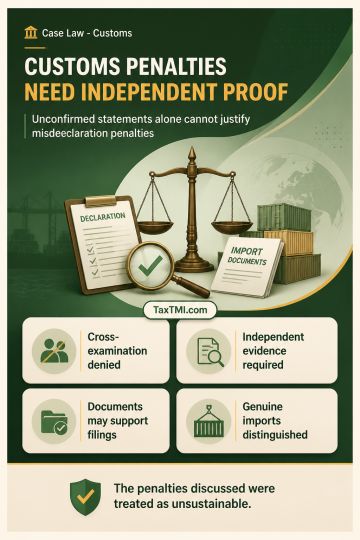
Cross-examination rights and corroborated evidence limit customs penalties for misdeclaration in genuine import transactions involving documented clea...
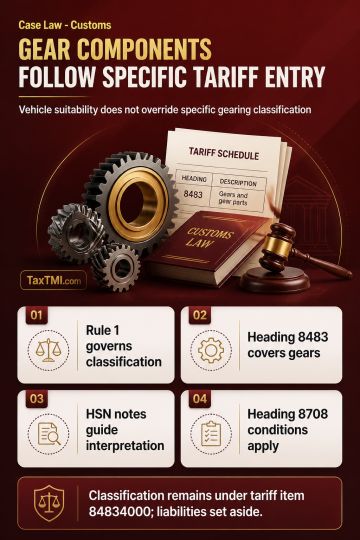
Tariff classification of vehicle gear components follows the specific gearing entry, displacing motor-vehicle parts classification and related liabili...
Necessary-party requirements limit impleadment of independent entities, while deferred consideration does not create an appealable adverse determinati...
Food supplement classification requires common parlance and authoritative tests, preventing treatment as proprietary Ayurvedic medicines without suppo...
The High Court examined the constitutional validity of exclusion (iii) to the Explanation to Section 17 of the CGST Act regarding the applicability to service providers. The authorities analyzed the matter from the perspective of definitions of 'plant' and machinery, relying on dictionaries, but did not focus on the functionality test. The Supreme Court held that a fact-finding inquiry is necessary in each case, applying the functionality test. As the Petitioner had yet to establish the requisite infrastructure when the Advance Ruling Authorities decided, the High Court remanded the matter to the AAR for a fresh ruling considering the Supreme Court's observations, given the limited scope of judicial review on factual matters unless perversity is demonstrated. The AAR and Appellate Authority's orders were set aside.
The High Court examined the constitutional validity of exclusion (iii) to the Explanation to Section 17 of the CGST Act regarding the applicability to service providers. The authorities analyzed the matter from the perspective of definitions of 'plant' and machinery, relying on dictionaries, but did not focus on the functionality test. The Supreme Court held that a fact-finding inquiry is necessary in each case, applying the functionality test. As the Petitioner had yet to establish the requisite infrastructure when the Advance Ruling Authorities decided, the High Court remanded the matter to the AAR for a fresh ruling considering the Supreme Court's observations, given the limited scope of judicial review on factual matters unless perversity is demonstrated. The AAR and Appellate Authority's orders were set aside.
Note: It is a system-generated summary and is for quick reference only.
 TaxTMI
 of 4805


















 Join Channel


 TaxTMI
