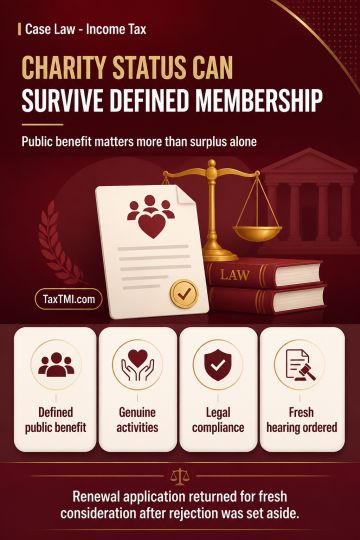
Defined public benefit can retain charitable character; registration renewal requires examining genuine activities and legal compliance, not surplus a...
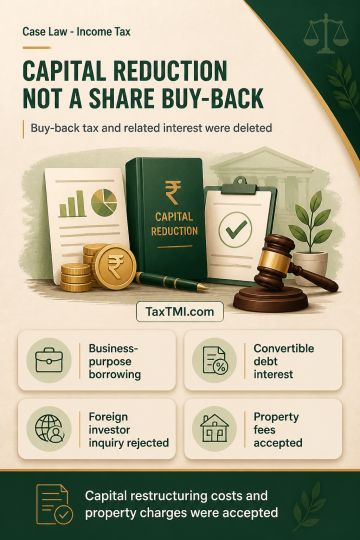
Capital reduction is distinct from share buy-back, preventing buy-back tax; restructuring interest and related business deductions also survive scruti...
Transfer pricing and tax deductions upheld on established principles, while employee contributions and warranty provisions returned for fresh examinat...
Captive transfer pricing relies on industrial consumer tariffs, while genuine quotations can benchmark effluent treatment transfers under the Other Me...
Specific tariff classification for ophthalmic instruments and extended limitation principles determine the treatment of duty demands, confiscation, an...
The case pertains to the validity of input tax credit (ITC) availed on construction goods for a building leased to an educational institution. The Supreme Court held that each case involving malls or buildings must undergo a fact-finding inquiry to determine if it satisfies the functionality test of being a 'plant' u/s 17(5)(d). If the building qualifies as a plant, ITC can be allowed on goods and services used in setting up the immovable property. The petitioner was required to satisfy the adjudicating authority whether the building qualified as a plant to avail ITC but failed to submit necessary documents and instead approached the court. The final order was passed, which the petitioner did not challenge. The court dismissed the petition, allowing the petitioner to file an appeal and rely on the Supreme Court's decision in the Safari Retreats case.
The case pertains to the validity of input tax credit (ITC) availed on construction goods for a building leased to an educational institution. The Supreme Court held that each case involving malls or buildings must undergo a fact-finding inquiry to determine if it satisfies the functionality test of being a 'plant' u/s 17(5)(d). If the building qualifies as a plant, ITC can be allowed on goods and services used in setting up the immovable property. The petitioner was required to satisfy the adjudicating authority whether the building qualified as a plant to avail ITC but failed to submit necessary documents and instead approached the court. The final order was passed, which the petitioner did not challenge. The court dismissed the petition, allowing the petitioner to file an appeal and rely on the Supreme Court's decision in the Safari Retreats case.
Note: It is a system-generated summary and is for quick reference only.
 TaxTMI
 of 4805
















 Join Channel


 TaxTMI

