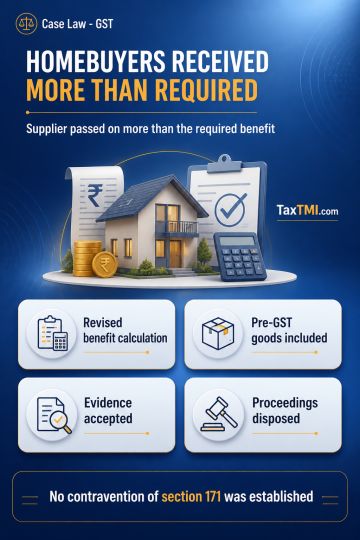
Necessary-party requirements limit impleadment of independent entities, while deferred consideration does not create an appealable adverse determinati...
Food supplement classification requires common parlance and authoritative tests, preventing treatment as proprietary Ayurvedic medicines without suppo...
Specified regulatory authority income receives conditional tax exemption, subject to non-commercial activity, unchanged income character, and return f...
Tax exemption for regulatory authority income applies retrospectively, subject to non-commercial activity, unchanged income sources, and return-filing...
Input tax credit conditions remain constitutionally valid, with eligible recipient claims considered under GST circulars and retrospective filing dead...
The case pertains to the validity of input tax credit (ITC) availed on construction goods for a building leased to an educational institution. The Supreme Court held that each case involving malls or buildings must undergo a fact-finding inquiry to determine if it satisfies the functionality test of being a 'plant' u/s 17(5)(d). If the building qualifies as a plant, ITC can be allowed on goods and services used in setting up the immovable property. The petitioner was required to satisfy the adjudicating authority whether the building qualified as a plant to avail ITC but failed to submit necessary documents and instead approached the court. The final order was passed, which the petitioner did not challenge. The court dismissed the petition, allowing the petitioner to file an appeal and rely on the Supreme Court's decision in the Safari Retreats case.
The case pertains to the validity of input tax credit (ITC) availed on construction goods for a building leased to an educational institution. The Supreme Court held that each case involving malls or buildings must undergo a fact-finding inquiry to determine if it satisfies the functionality test of being a 'plant' u/s 17(5)(d). If the building qualifies as a plant, ITC can be allowed on goods and services used in setting up the immovable property. The petitioner was required to satisfy the adjudicating authority whether the building qualified as a plant to avail ITC but failed to submit necessary documents and instead approached the court. The final order was passed, which the petitioner did not challenge. The court dismissed the petition, allowing the petitioner to file an appeal and rely on the Supreme Court's decision in the Safari Retreats case.
Note: It is a system-generated summary and is for quick reference only.
 TaxTMI
 of 4805




















 Join Channel


 TaxTMI