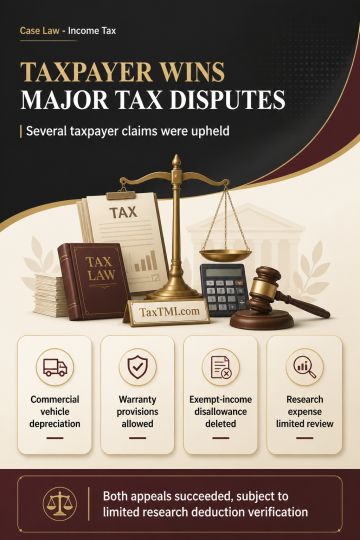
Commercial vehicle depreciation, scientifically determined warranty provisions and exempt-income disallowances were resolved in favour of the taxpayer...
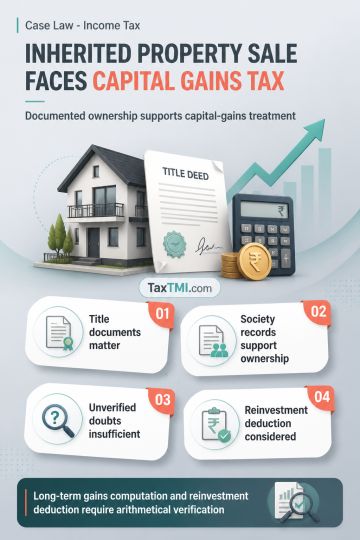
Inherited property sale proceeds require capital-gains treatment where ownership is supported by evidence, not suspicion or unverified signature doubt...
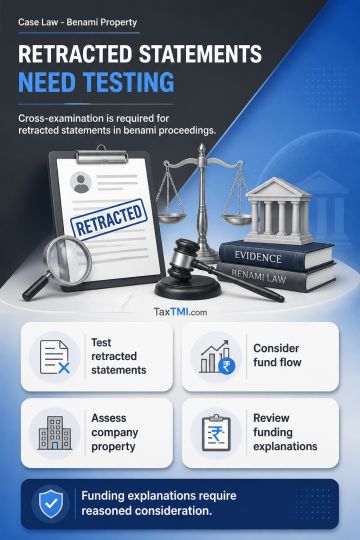
Cross-examination of retracted statements is essential where foundational evidence supports a benami allegation and documented funding explanations re...
Capital-goods exemption covers plant-modernisation accessories, while the import restriction applies only to earlier capital-goods components and spar...
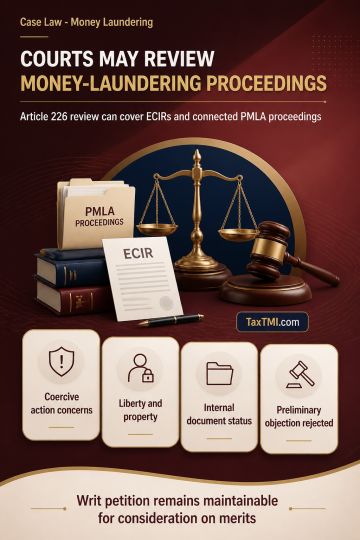
Constitutional judicial review permits challenges to ECIRs and connected money-laundering proceedings where coercive action affects fundamental intere...
The High Court dismissed the appeals, holding that the Customs, Excise and Service Tax Appellate Tribunal (CESTAT) correctly set aside the order imposing penalties u/ss 114 and 114AA of the Customs Act, 1962. The Department failed to follow the procedure u/s 138B of the Act by denying the exporter's request to cross-examine the Chemical Examiner whose report formed the basis of the allegations. The CESTAT rightly found that the statements relied upon could not be used as relevant evidence without affording the exporter an opportunity for cross-examination, as mandated by Section 138B, unless exceptional circumstances existed, which were not present in this case. The High Court upheld the CESTAT's decision, as no substantial question of law arose.
The High Court dismissed the appeals, holding that the Customs, Excise and Service Tax Appellate Tribunal (CESTAT) correctly set aside the order imposing penalties u/ss 114 and 114AA of the Customs Act, 1962. The Department failed to follow the procedure u/s 138B of the Act by denying the exporter's request to cross-examine the Chemical Examiner whose report formed the basis of the allegations. The CESTAT rightly found that the statements relied upon could not be used as relevant evidence without affording the exporter an opportunity for cross-examination, as mandated by Section 138B, unless exceptional circumstances existed, which were not present in this case. The High Court upheld the CESTAT's decision, as no substantial question of law arose.
Note: It is a system-generated summary and is for quick reference only.
 TaxTMI
  TaxTMI
 of 4828





 Join Channel


