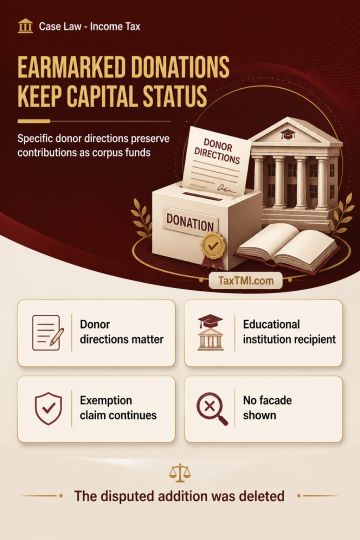
Donor-directed corpus contributions retain capital character despite exemption claims under section 10(23C)(vi), preventing their treatment as taxable...
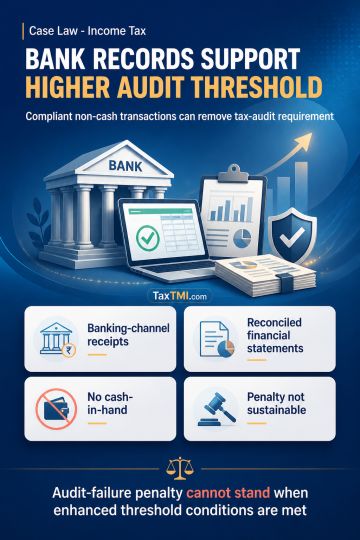
Enhanced tax-audit threshold applies where banking records establish compliant non-cash receipts and payments, eliminating penalty exposure for audit ...
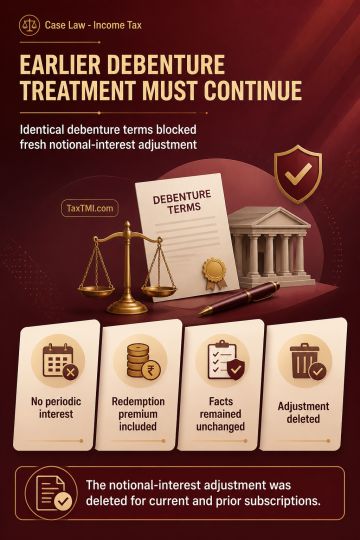
Transfer pricing consistency protects identical non-interest-bearing debenture terms from a later notional-interest adjustment without valid statutory...
Page of 4819
Press 'Enter' after typing page number.
281 to 300 of 96365 Results
❮
❯
❯❯
0 / 200
Expand Note
Add to Folder
No Folders have been created
+
Are you sure you want to delete "My most important" ?
The High Court dismissed the appeals, holding that the Customs, Excise and Service Tax Appellate Tribunal (CESTAT) correctly set aside the order imposing penalties u/ss 114 and 114AA of the Customs Act, 1962. The Department failed to follow the procedure u/s 138B of the Act by denying the exporter's request to cross-examine the Chemical Examiner whose report formed the basis of the allegations. The CESTAT rightly found that the statements relied upon could not be used as relevant evidence without affording the exporter an opportunity for cross-examination, as mandated by Section 138B, unless exceptional circumstances existed, which were not present in this case. The High Court upheld the CESTAT's decision, as no substantial question of law arose.
The High Court dismissed the appeals, holding that the Customs, Excise and Service Tax Appellate Tribunal (CESTAT) correctly set aside the order imposing penalties u/ss 114 and 114AA of the Customs Act, 1962. The Department failed to follow the procedure u/s 138B of the Act by denying the exporter's request to cross-examine the Chemical Examiner whose report formed the basis of the allegations. The CESTAT rightly found that the statements relied upon could not be used as relevant evidence without affording the exporter an opportunity for cross-examination, as mandated by Section 138B, unless exceptional circumstances existed, which were not present in this case. The High Court upheld the CESTAT's decision, as no substantial question of law arose.
Note: It is a system-generated summary and is for quick reference only.
 TaxTMI
  TaxTMI
 of 4819




 Join Channel