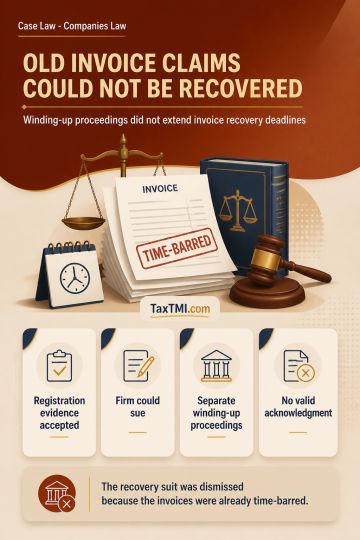
Invoice-based recovery claims remain time-barred despite separate winding-up proceedings, absent valid acknowledgment or part-payment of the disputed ...
Extended limitation fails without specific suppression allegations, while overseas employee secondment remains taxable as manpower supply within norma...
Time-share accommodation classification excludes Club or Association Service where purchasers receive contractual occupancy rights without genuine mem...
CENVAT credit for trading requires reversal, while taxable-service rental credit remains proportionately available and limitation issues await resolut...
Vicarious liability for dishonoured company cheques may extend to non-signatory directors where complaints contain foundational responsibility avermen...
This case deals with the applicability of customs duty exemption under Notification No. 12/2012-Cus for imports made before and after its amendment by Notification No. 06/2017-Cus, and the applicability of depreciation provisions under Clause (e) of Condition 40A post-amendment. The key points are: Prior to the amendment, the exemption was available without any depreciation clause, as per the CLOUGH ENGINEERING LTD. case. After the amendment, duty became payable on leftover goods with prescribed depreciation rates. The confiscation demand and penalties were set aside, as the notification itself foresaw the possibility of leftovers and disposal. The case was remanded for fresh adjudication considering the depreciation provisions for post-amendment imports.
This case deals with the applicability of customs duty exemption under Notification No. 12/2012-Cus for imports made before and after its amendment by Notification No. 06/2017-Cus, and the applicability of depreciation provisions under Clause (e) of Condition 40A post-amendment. The key points are: Prior to the amendment, the exemption was available without any depreciation clause, as per the CLOUGH ENGINEERING LTD. case. After the amendment, duty became payable on leftover goods with prescribed depreciation rates. The confiscation demand and penalties were set aside, as the notification itself foresaw the possibility of leftovers and disposal. The case was remanded for fresh adjudication considering the depreciation provisions for post-amendment imports.
Note: It is a system-generated summary and is for quick reference only.
 TaxTMI
  TaxTMI
 of 4826


















 Join Channel