Service permanent establishment requires non-auxiliary services, while arm's-length distributor remuneration precludes further profit attribution in I...
Make-available condition excludes standard SaaS subscription receipts where customers receive no independently usable technical knowledge after subscr...
Anonymous donation classification fails where charitable trusts maintain undisputed donor identity records and evidence corpus contributions' intended...
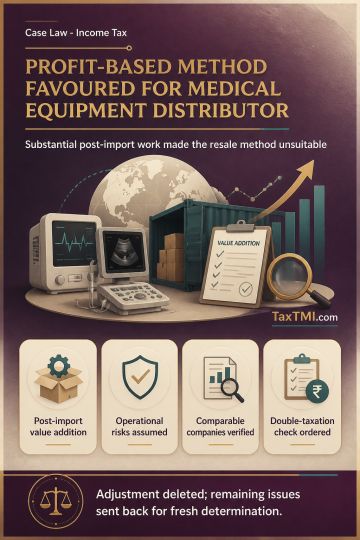
Transfer pricing method selection favours TNMM where medical-equipment distribution involves substantial post-import value addition and operational ri...
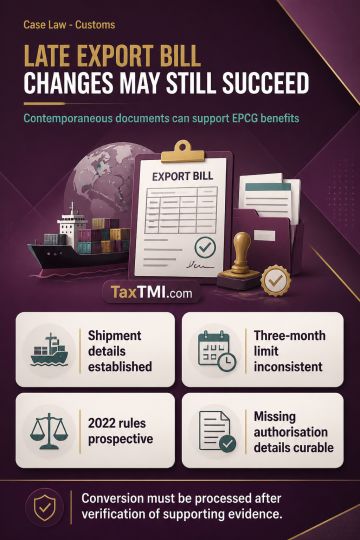
Post-export shipping bill conversion remains available where contemporaneous evidence supports EPCG benefits despite curable procedural omissions and ...
This case deals with the applicability of customs duty exemption under Notification No. 12/2012-Cus for imports made before and after its amendment by Notification No. 06/2017-Cus, and the applicability of depreciation provisions under Clause (e) of Condition 40A post-amendment. The key points are: Prior to the amendment, the exemption was available without any depreciation clause, as per the CLOUGH ENGINEERING LTD. case. After the amendment, duty became payable on leftover goods with prescribed depreciation rates. The confiscation demand and penalties were set aside, as the notification itself foresaw the possibility of leftovers and disposal. The case was remanded for fresh adjudication considering the depreciation provisions for post-amendment imports.
This case deals with the applicability of customs duty exemption under Notification No. 12/2012-Cus for imports made before and after its amendment by Notification No. 06/2017-Cus, and the applicability of depreciation provisions under Clause (e) of Condition 40A post-amendment. The key points are: Prior to the amendment, the exemption was available without any depreciation clause, as per the CLOUGH ENGINEERING LTD. case. After the amendment, duty became payable on leftover goods with prescribed depreciation rates. The confiscation demand and penalties were set aside, as the notification itself foresaw the possibility of leftovers and disposal. The case was remanded for fresh adjudication considering the depreciation provisions for post-amendment imports.
Note: It is a system-generated summary and is for quick reference only.
 TaxTMI
  TaxTMI
 of 4821

















 Join Channel