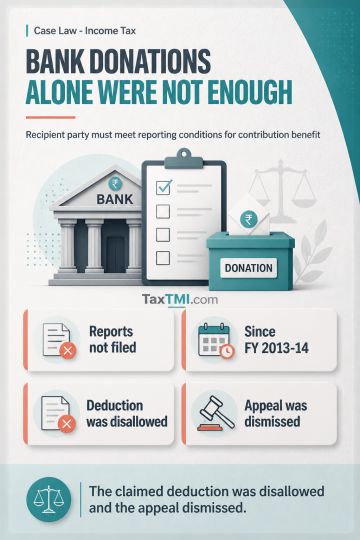
Political contribution deductions require recipient party compliance with contribution-reporting conditions; banking-channel donations alone do not qu...
Aggregation under TNMM prevents selective testing of intra-group services without comparable uncontrolled transactions, while appellate additional cla...
Protective assessment cannot duplicate identical receipts under competing characterisations; remote services did not establish a taxable permanent est...
Current account treatment of overseas tournament services removed most FEMA findings, but excess EEFC remittance and delayed repatriation remained bre...
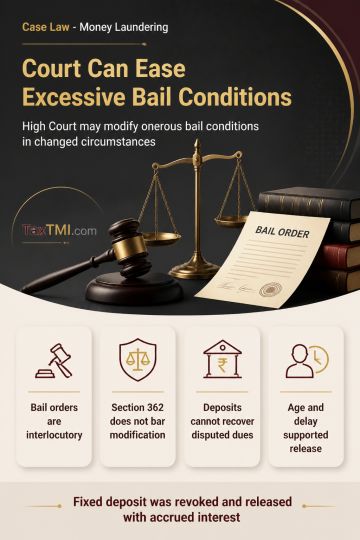
Modification of bail conditions remains available through inherent jurisdiction where onerous deposits undermine justice and cannot recover disputed d...
Merchant banker regulation consolidates registration, governance, capital, reporting, outsourcing and investor-protection requirements under an update...
The NCLAT erred in invoking its inherent powers u/r 11 of the NCLAT Rules 2016 to approve a settlement between the second respondent and the Corporate Debtor, circumventing the prescribed procedure for withdrawal of CIRP u/s 12A and Regulation 30A. The inherent powers cannot override specific legal provisions exhaustively providing a procedure. The NCLAT failed to provide reasons for deviating from the withdrawal procedure or the urgency necessitating approval without following due process. Once CIRP commenced, it became a collective proceeding involving all creditors as stakeholders. The NCLAT inadequately addressed the appellant's objections regarding the ongoing ED investigation against the respondents and attempts by the Corporate Debtor to dissipate assets. Despite the appellant not being a party to the settlement, it has locus standi as an aggrieved person u/ss 61 and 62 of the IBC to challenge the NCLAT order before the Supreme Court. The impugned NCLAT judgment is set aside.
The NCLAT erred in invoking its inherent powers u/r 11 of the NCLAT Rules 2016 to approve a settlement between the second respondent and the Corporate Debtor, circumventing the prescribed procedure for withdrawal of CIRP u/s 12A and Regulation 30A. The inherent powers cannot override specific legal provisions exhaustively providing a procedure. The NCLAT failed to provide reasons for deviating from the withdrawal procedure or the urgency necessitating approval without following due process. Once CIRP commenced, it became a collective proceeding involving all creditors as stakeholders. The NCLAT inadequately addressed the appellant's objections regarding the ongoing ED investigation against the respondents and attempts by the Corporate Debtor to dissipate assets. Despite the appellant not being a party to the settlement, it has locus standi as an aggrieved person u/ss 61 and 62 of the IBC to challenge the NCLAT order before the Supreme Court. The impugned NCLAT judgment is set aside.
Note: It is a system-generated summary and is for quick reference only.
 TaxTMI
  TaxTMI
 of 4828



















 Join Channel