Opportunity to respond to jurisdictional reports is mandatory before customs settlement duty enhancement; connected applications require consistent ad...
Specific customs headings for scaffolding components prevail over general classification, invalidating misclassification proceedings and enabling with...
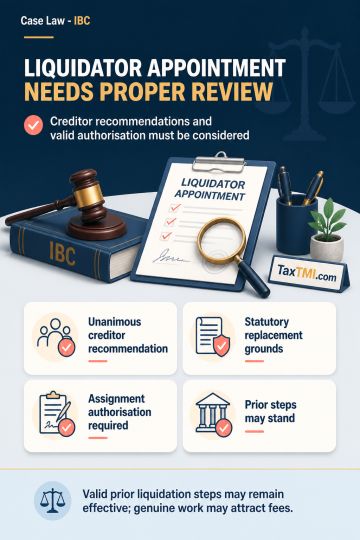
Liquidator appointment under Section 34 requires consideration of creditor recommendations, valid professional authorisation, and preservation of vali...
The NCLAT erred in invoking its inherent powers u/r 11 of the NCLAT Rules 2016 to approve a settlement between the second respondent and the Corporate Debtor, circumventing the prescribed procedure for withdrawal of CIRP u/s 12A and Regulation 30A. The inherent powers cannot override specific legal provisions exhaustively providing a procedure. The NCLAT failed to provide reasons for deviating from the withdrawal procedure or the urgency necessitating approval without following due process. Once CIRP commenced, it became a collective proceeding involving all creditors as stakeholders. The NCLAT inadequately addressed the appellant's objections regarding the ongoing ED investigation against the respondents and attempts by the Corporate Debtor to dissipate assets. Despite the appellant not being a party to the settlement, it has locus standi as an aggrieved person u/ss 61 and 62 of the IBC to challenge the NCLAT order before the Supreme Court. The impugned NCLAT judgment is set aside.
The NCLAT erred in invoking its inherent powers u/r 11 of the NCLAT Rules 2016 to approve a settlement between the second respondent and the Corporate Debtor, circumventing the prescribed procedure for withdrawal of CIRP u/s 12A and Regulation 30A. The inherent powers cannot override specific legal provisions exhaustively providing a procedure. The NCLAT failed to provide reasons for deviating from the withdrawal procedure or the urgency necessitating approval without following due process. Once CIRP commenced, it became a collective proceeding involving all creditors as stakeholders. The NCLAT inadequately addressed the appellant's objections regarding the ongoing ED investigation against the respondents and attempts by the Corporate Debtor to dissipate assets. Despite the appellant not being a party to the settlement, it has locus standi as an aggrieved person u/ss 61 and 62 of the IBC to challenge the NCLAT order before the Supreme Court. The impugned NCLAT judgment is set aside.
Note: It is a system-generated summary and is for quick reference only.
 TaxTMI
  TaxTMI
 of 4826




















 Join Channel


