Online bond platforms may offer overseas-regulated products and tax-specific bonds subject to disclosures, compliance safeguards and revised complianc...
Corporate guarantee valuation permits actual ascertainable commission while barring retroactive application and extended-period penalties for bona fid...
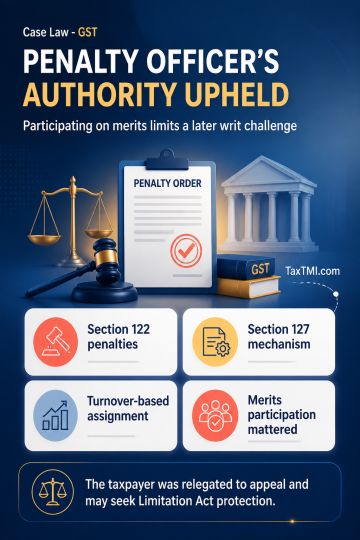
Proper-officer jurisdiction under UPGST penalty provisions upheld; participation on merits prevents bypassing the statutory appellate remedy through w...
Transitioned CENVAT credit may validly satisfy mandatory pre-deposit requirements for legacy service tax appeals through Electronic Credit Ledger debi...
Building-plan sanction charges require statutory authority; unauthorised fees and GST were quashed, while labour cess must follow prescribed collectio...
Pure-agent exclusion fails where hotel booking facilitators receive third-party services themselves, making entire customer consideration taxable as r...
Transfer pricing requires evidence for AMP transactions, functionally reliable comparables, and appropriate aggregation or Berry Ratio benchmarking me...
The NCLAT erred in invoking its inherent powers u/r 11 of the NCLAT Rules 2016 to approve a settlement between the second respondent and the Corporate Debtor, circumventing the prescribed procedure for withdrawal of CIRP u/s 12A and Regulation 30A. The inherent powers cannot override specific legal provisions exhaustively providing a procedure. The NCLAT failed to provide reasons for deviating from the withdrawal procedure or the urgency necessitating approval without following due process. Once CIRP commenced, it became a collective proceeding involving all creditors as stakeholders. The NCLAT inadequately addressed the appellant's objections regarding the ongoing ED investigation against the respondents and attempts by the Corporate Debtor to dissipate assets. Despite the appellant not being a party to the settlement, it has locus standi as an aggrieved person u/ss 61 and 62 of the IBC to challenge the NCLAT order before the Supreme Court. The impugned NCLAT judgment is set aside.
The NCLAT erred in invoking its inherent powers u/r 11 of the NCLAT Rules 2016 to approve a settlement between the second respondent and the Corporate Debtor, circumventing the prescribed procedure for withdrawal of CIRP u/s 12A and Regulation 30A. The inherent powers cannot override specific legal provisions exhaustively providing a procedure. The NCLAT failed to provide reasons for deviating from the withdrawal procedure or the urgency necessitating approval without following due process. Once CIRP commenced, it became a collective proceeding involving all creditors as stakeholders. The NCLAT inadequately addressed the appellant's objections regarding the ongoing ED investigation against the respondents and attempts by the Corporate Debtor to dissipate assets. Despite the appellant not being a party to the settlement, it has locus standi as an aggrieved person u/ss 61 and 62 of the IBC to challenge the NCLAT order before the Supreme Court. The impugned NCLAT judgment is set aside.
Note: It is a system-generated summary and is for quick reference only.
 TaxTMI
  TaxTMI
 of 4817




















 Join Channel


