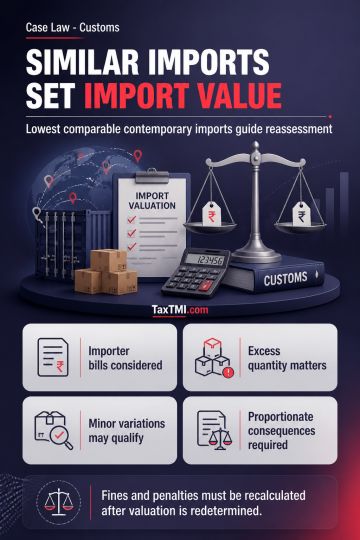
Customs valuation must use comparable contemporary imports, while confiscation fines and penalties require proportionate recalculation on reassessed v...
Depositor-protection proceedings prevail over corporate insolvency, while liquidators may recover chit receivables using copies of seized company reco...
Intermediary service classification fails where overseas admission facilitation is supplied independently, preserving export treatment and small-provi...
Satellite transponder bandwidth is telecommunication, not Business Support Service; foreign non-telegraph providers triggered no service tax liability...
Commitment proceedings gain extended timelines, structured defect refiling, and automatic resumption of inquiry after the adjusted completion period e...
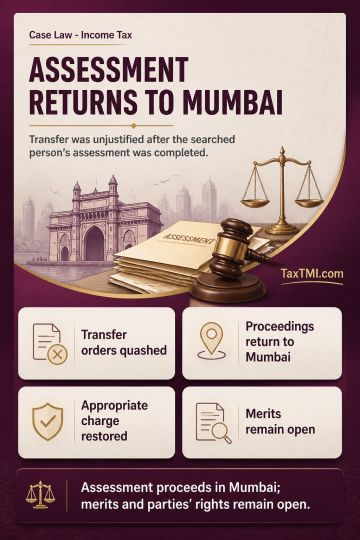
Centralised assessment transfer becomes unwarranted once the searched person's assessment is complete, requiring restoration to the appropriate charge...
Page of 4817
Press 'Enter' after typing page number.
321 to 340 of 96333 Results
❮
❯
❯❯
0 / 200
Expand Note
Add to Folder
No Folders have been created
+
Are you sure you want to delete "My most important" ?
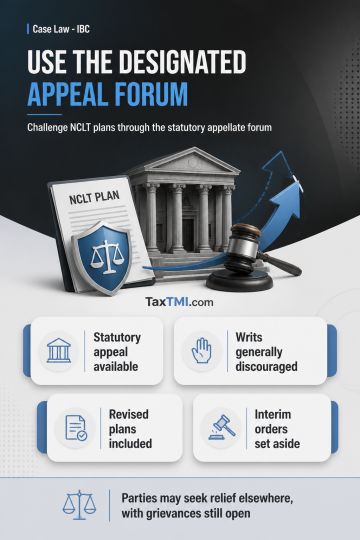
The NCLAT erred in invoking its inherent powers u/r 11 of the NCLAT Rules 2016 to approve a settlement between the second respondent and the Corporate Debtor, circumventing the prescribed procedure for withdrawal of CIRP u/s 12A and Regulation 30A. The inherent powers cannot override specific legal provisions exhaustively providing a procedure. The NCLAT failed to provide reasons for deviating from the withdrawal procedure or the urgency necessitating approval without following due process. Once CIRP commenced, it became a collective proceeding involving all creditors as stakeholders. The NCLAT inadequately addressed the appellant's objections regarding the ongoing ED investigation against the respondents and attempts by the Corporate Debtor to dissipate assets. Despite the appellant not being a party to the settlement, it has locus standi as an aggrieved person u/ss 61 and 62 of the IBC to challenge the NCLAT order before the Supreme Court. The impugned NCLAT judgment is set aside.
The NCLAT erred in invoking its inherent powers u/r 11 of the NCLAT Rules 2016 to approve a settlement between the second respondent and the Corporate Debtor, circumventing the prescribed procedure for withdrawal of CIRP u/s 12A and Regulation 30A. The inherent powers cannot override specific legal provisions exhaustively providing a procedure. The NCLAT failed to provide reasons for deviating from the withdrawal procedure or the urgency necessitating approval without following due process. Once CIRP commenced, it became a collective proceeding involving all creditors as stakeholders. The NCLAT inadequately addressed the appellant's objections regarding the ongoing ED investigation against the respondents and attempts by the Corporate Debtor to dissipate assets. Despite the appellant not being a party to the settlement, it has locus standi as an aggrieved person u/ss 61 and 62 of the IBC to challenge the NCLAT order before the Supreme Court. The impugned NCLAT judgment is set aside.
Note: It is a system-generated summary and is for quick reference only.
 TaxTMI
  TaxTMI
 of 4817



















 Join Channel