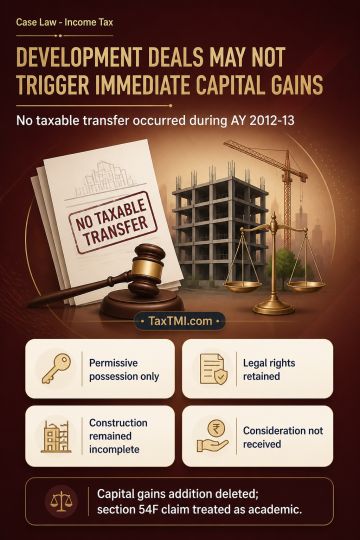
Development agreements require legal possession or effective enjoyment for capital gains transfer; permissive possession and deferred consideration de...
Prolonged sterilisation of development rights supports capital-gains treatment, while business-income disallowances cannot govern capital-gains comput...
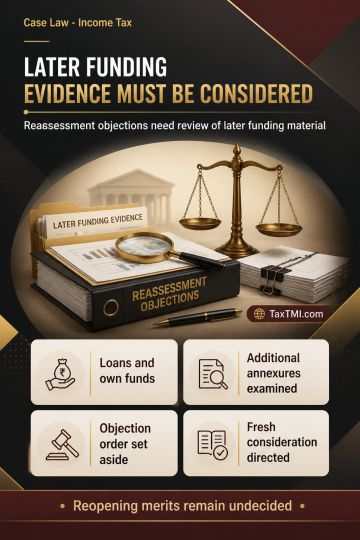
Additional evidence in transfer pricing dispute leads to fresh examination, while tax deductions, TDS credit, fee and refund interest require verifica...
Category II AIF pass-through taxation preserves non-business income character; investment receipts cannot be reclassified without applying recognised ...
The case pertains to the recovery of customs duty in the form of IGST forgone during imports under the advance authorization scheme from October 2017 to November 2018. The appellant had fulfilled the pre-import condition in most cases, and in some cases, the bill of entry was re-assessed, and the appellant paid the IGST, which they did not contest as they were eligible for ITC under GST. The demand for IGST, along with interest, fine, and penalties, is deemed unsustainable as there was no mala fide on the appellant's part, and the penalty corresponding to the duty paid, which is not in contest, is also not sustainable on the ground of revenue neutrality. The issue involved the interpretation of the exemption notification on advance authorization, and the suppression of facts cannot be attributed to the appellant. Therefore, the extended period for demand is prima facie not invokable, and the appellant has made out a strong prima facie case on the time bar. The impugned order is unsustainable, and the appeal is allowed.
The case pertains to the recovery of customs duty in the form of IGST forgone during imports under the advance authorization scheme from October 2017 to November 2018. The appellant had fulfilled the pre-import condition in most cases, and in some cases, the bill of entry was re-assessed, and the appellant paid the IGST, which they did not contest as they were eligible for ITC under GST. The demand for IGST, along with interest, fine, and penalties, is deemed unsustainable as there was no mala fide on the appellant's part, and the penalty corresponding to the duty paid, which is not in contest, is also not sustainable on the ground of revenue neutrality. The issue involved the interpretation of the exemption notification on advance authorization, and the suppression of facts cannot be attributed to the appellant. Therefore, the extended period for demand is prima facie not invokable, and the appellant has made out a strong prima facie case on the time bar. The impugned order is unsustainable, and the appeal is allowed.
Note: It is a system-generated summary and is for quick reference only.
 TaxTMI
 of 4807
















 Join Channel


 TaxTMI
