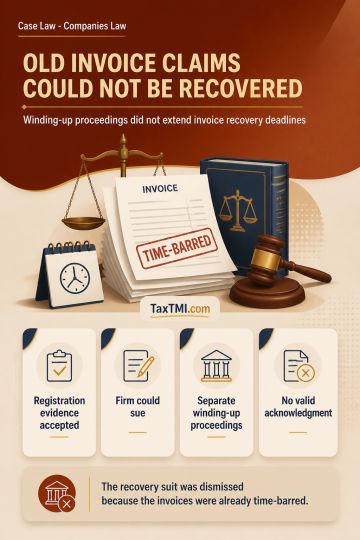
Invoice-based recovery claims remain time-barred despite separate winding-up proceedings, absent valid acknowledgment or part-payment of the disputed ...
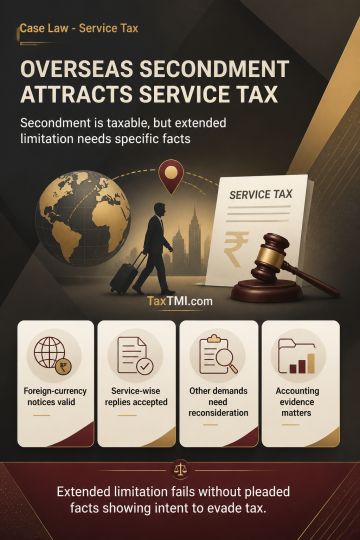
Extended limitation fails without specific suppression allegations, while overseas employee secondment remains taxable as manpower supply within norma...
Time-share accommodation classification excludes Club or Association Service where purchasers receive contractual occupancy rights without genuine mem...
CENVAT credit for trading requires reversal, while taxable-service rental credit remains proportionately available and limitation issues await resolut...
Vicarious liability for dishonoured company cheques may extend to non-signatory directors where complaints contain foundational responsibility avermen...
The case pertains to the recovery of customs duty in the form of IGST forgone during imports under the advance authorization scheme from October 2017 to November 2018. The appellant had fulfilled the pre-import condition in most cases, and in some cases, the bill of entry was re-assessed, and the appellant paid the IGST, which they did not contest as they were eligible for ITC under GST. The demand for IGST, along with interest, fine, and penalties, is deemed unsustainable as there was no mala fide on the appellant's part, and the penalty corresponding to the duty paid, which is not in contest, is also not sustainable on the ground of revenue neutrality. The issue involved the interpretation of the exemption notification on advance authorization, and the suppression of facts cannot be attributed to the appellant. Therefore, the extended period for demand is prima facie not invokable, and the appellant has made out a strong prima facie case on the time bar. The impugned order is unsustainable, and the appeal is allowed.
The case pertains to the recovery of customs duty in the form of IGST forgone during imports under the advance authorization scheme from October 2017 to November 2018. The appellant had fulfilled the pre-import condition in most cases, and in some cases, the bill of entry was re-assessed, and the appellant paid the IGST, which they did not contest as they were eligible for ITC under GST. The demand for IGST, along with interest, fine, and penalties, is deemed unsustainable as there was no mala fide on the appellant's part, and the penalty corresponding to the duty paid, which is not in contest, is also not sustainable on the ground of revenue neutrality. The issue involved the interpretation of the exemption notification on advance authorization, and the suppression of facts cannot be attributed to the appellant. Therefore, the extended period for demand is prima facie not invokable, and the appellant has made out a strong prima facie case on the time bar. The impugned order is unsustainable, and the appeal is allowed.
Note: It is a system-generated summary and is for quick reference only.
 TaxTMI
 of 4803










 Join Channel


 TaxTMI