Defined public benefit can retain charitable character; registration renewal requires examining genuine activities and legal compliance, not surplus a...
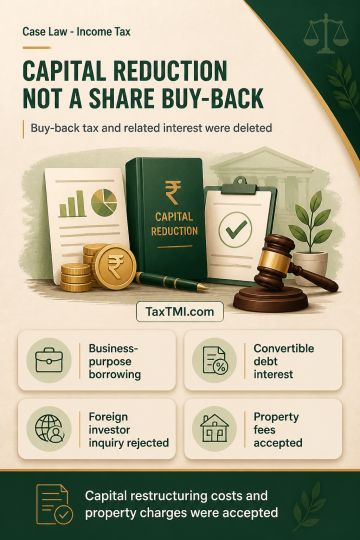
Capital reduction is distinct from share buy-back, preventing buy-back tax; restructuring interest and related business deductions also survive scruti...
Transfer pricing and tax deductions upheld on established principles, while employee contributions and warranty provisions returned for fresh examinat...
Captive transfer pricing relies on industrial consumer tariffs, while genuine quotations can benchmark effluent treatment transfers under the Other Me...
Specific tariff classification for ophthalmic instruments and extended limitation principles determine the treatment of duty demands, confiscation, an...
The activity of filling imported Hepta Propane/FM-200 gas from bulk containers into smaller empty cylinders does not constitute a manufacturing process under Note 9 to Chapter 38 of the Central Excise Tariff Act, 1985. The refilling process involves transferring the gas under high pressure using nitrogen gas, without any perceptible change or treatment to render the product marketable. The imported gas and nitrogen gas remain unaltered after refilling into the cylinders. The Circular No. 342/58/97-CX clarifies that simply transferring material from one container to another does not qualify as "packing" to be considered manufacturing. The Tribunal's decision aligns with previous rulings, including M/s 3M India Ltd. and Commissioner of Central Excise, Vadodara v. M/s Vadilal Gases Ltd., which held that mixing gases without chemical reactions or creating new products does not amount to manufacturing under the relevant chapter note. Consequently, the appellants' activity does not attract central excise duty, and the impugned order imposing duty and penalty cannot be sustained.
The activity of filling imported Hepta Propane/FM-200 gas from bulk containers into smaller empty cylinders does not constitute a manufacturing process under Note 9 to Chapter 38 of the Central Excise Tariff Act, 1985. The refilling process involves transferring the gas under high pressure using nitrogen gas, without any perceptible change or treatment to render the product marketable. The imported gas and nitrogen gas remain unaltered after refilling into the cylinders. The Circular No. 342/58/97-CX clarifies that simply transferring material from one container to another does not qualify as "packing" to be considered manufacturing. The Tribunal's decision aligns with previous rulings, including M/s 3M India Ltd. and Commissioner of Central Excise, Vadodara v. M/s Vadilal Gases Ltd., which held that mixing gases without chemical reactions or creating new products does not amount to manufacturing under the relevant chapter note. Consequently, the appellants' activity does not attract central excise duty, and the impugned order imposing duty and penalty cannot be sustained.
Note: It is a system-generated summary and is for quick reference only.
 TaxTMI
 of 4805

















 Join Channel


 TaxTMI

