Development agreements require legal possession or effective enjoyment for capital gains transfer; permissive possession and deferred consideration de...
Prolonged sterilisation of development rights supports capital-gains treatment, while business-income disallowances cannot govern capital-gains comput...
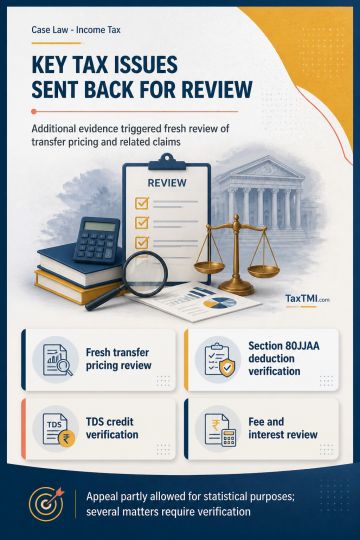
Additional evidence in transfer pricing dispute leads to fresh examination, while tax deductions, TDS credit, fee and refund interest require verifica...
Category II AIF pass-through taxation preserves non-business income character; investment receipts cannot be reclassified without applying recognised ...
Classification of imported goods, specifically di-methyl lauryl amine (DMLA), under the Customs Tariff Act, 1975. The key points are: The classification of DMLA as a 'surface active agent' under heading 3402 was disputed. The test reports submitted were questioned for their validity and bona fides. The adjudicating authority did not consider the test reports furnished by the importer. The Supreme Court's ruling in Hindustan Ferodo Ltd v. Collector of Central Excise emphasizes that the onus of establishing the classification lies with the Revenue, and if evidence is not led, the appeal should be allowed. The benchmark in note 3 of chapter 34 of the Customs Tariff Act, 1975, must be met through valid test results. The order was set aside for fresh adjudication after considering the test results. The penalties imposed on individuals were found unsustainable and set aside. The dispute was remanded back to the original authority for fresh adjudication.
Classification of imported goods, specifically di-methyl lauryl amine (DMLA), under the Customs Tariff Act, 1975. The key points are: The classification of DMLA as a 'surface active agent' under heading 3402 was disputed. The test reports submitted were questioned for their validity and bona fides. The adjudicating authority did not consider the test reports furnished by the importer. The Supreme Court's ruling in Hindustan Ferodo Ltd v. Collector of Central Excise emphasizes that the onus of establishing the classification lies with the Revenue, and if evidence is not led, the appeal should be allowed. The benchmark in note 3 of chapter 34 of the Customs Tariff Act, 1975, must be met through valid test results. The order was set aside for fresh adjudication after considering the test results. The penalties imposed on individuals were found unsustainable and set aside. The dispute was remanded back to the original authority for fresh adjudication.
Note: It is a system-generated summary and is for quick reference only.
 TaxTMI
 of 4801















 Join Channel


 TaxTMI