Defined public benefit can retain charitable character; registration renewal requires examining genuine activities and legal compliance, not surplus a...
Capital reduction is distinct from share buy-back, preventing buy-back tax; restructuring interest and related business deductions also survive scruti...
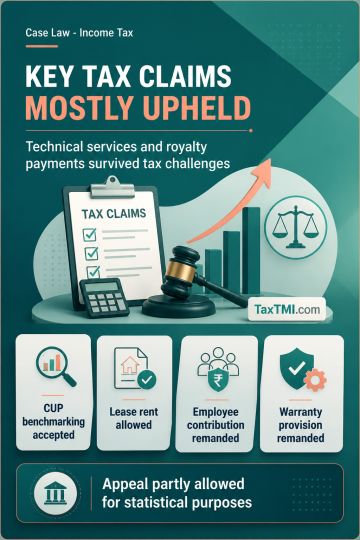
Transfer pricing and tax deductions upheld on established principles, while employee contributions and warranty provisions returned for fresh examinat...
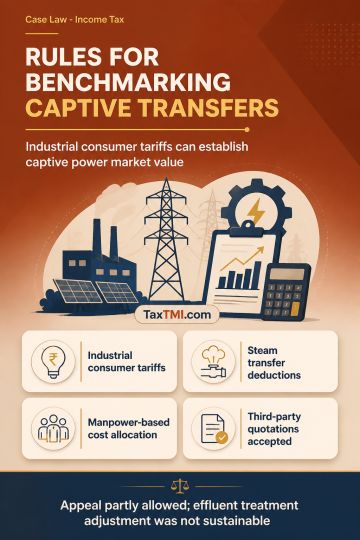
Captive transfer pricing relies on industrial consumer tariffs, while genuine quotations can benchmark effluent treatment transfers under the Other Me...
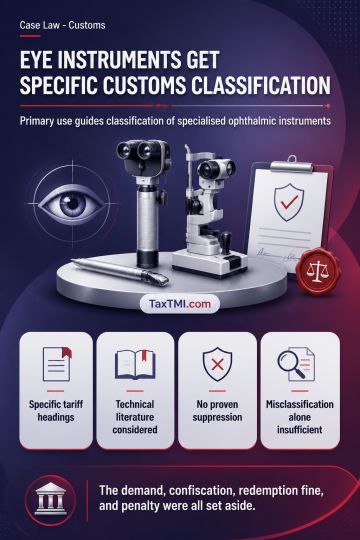
Specific tariff classification for ophthalmic instruments and extended limitation principles determine the treatment of duty demands, confiscation, an...
Integrated golf function determines classification, placing launch monitors and simulators under other golf equipment rather than measuring instrument...
The court held that the revenue authorities cannot question the decision of the Development Commissioner regarding bunching of products for domestic tariff area (DTA) sale within the six-digit Harmonized System (HS) code. In light of the judgments in Ginni International Ltd. and Virlon Textile Mills Ltd., the revenue cannot go beyond or behind the Development Commissioner's decision. The court found no provision in Section 3(1) of the Central Excise Act, 1944, or Rule 100(A) of the Central Excise Rules, 1944, that empowers the revenue authorities to challenge the Development Commissioner's decision. Consequently, the court dismissed the appeal.
The court held that the revenue authorities cannot question the decision of the Development Commissioner regarding bunching of products for domestic tariff area (DTA) sale within the six-digit Harmonized System (HS) code. In light of the judgments in Ginni International Ltd. and Virlon Textile Mills Ltd., the revenue cannot go beyond or behind the Development Commissioner's decision. The court found no provision in Section 3(1) of the Central Excise Act, 1944, or Rule 100(A) of the Central Excise Rules, 1944, that empowers the revenue authorities to challenge the Development Commissioner's decision. Consequently, the court dismissed the appeal.
Note: It is a system-generated summary and is for quick reference only.
 TaxTMI
 of 4794














 Join Channel


 TaxTMI
