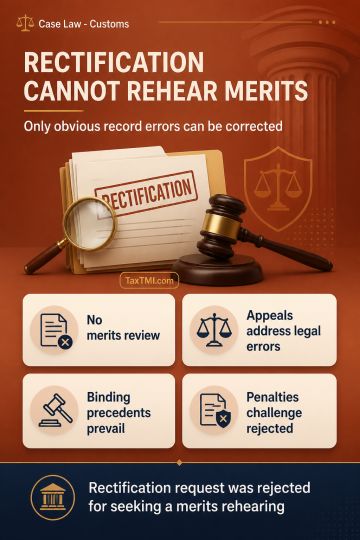
Rectification of mistake remains limited to self-evident record errors, preventing merits review through miscellaneous applications and preserving fin...
Tender creditworthiness conditions may extend to de facto Promoter Directors, with post-participation challenges generally barred absent arbitrariness...
Corporate representation in PMLA summons proceedings permitted through an authorised signatory, subject to directors' continuing cooperation and atten...
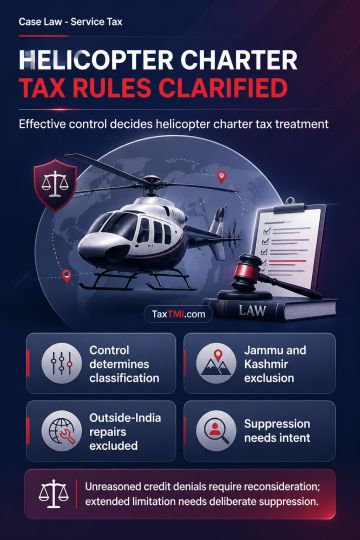
Helicopter charter classification requires effective control analysis, while territorial performance, reasoned credit orders and wilful suppression de...
Specified fund definition expands PAN exemption eligibility for registered alternative investment funds and qualifying International Financial Service...
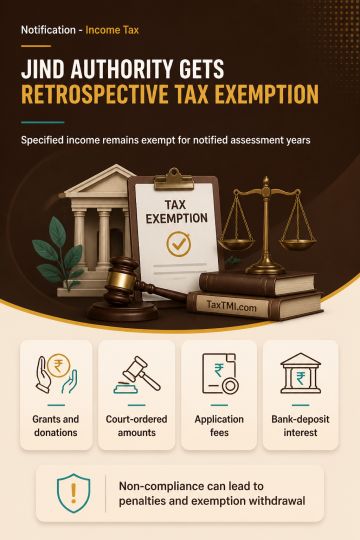
Tax exemption for specified legal-services authority income applies retrospectively, subject to non-commercial activity, unchanged income sources, and...
Page of 4784
Press 'Enter' after typing page number.
541 to 560 of 95673 Results
❮
❯
❯❯
0 / 200
Expand Note
Add to Folder
No Folders have been created
+
Are you sure you want to delete "My most important" ?
This instruction clarifies certain aspects of origin procedures under free trade agreements (FTAs), particularly regarding third-party invoicing. It emphasizes that the purpose of a certificate of origin (COO) is to serve as proof that goods qualify as originating under an FTA, irrespective of third-party invoicing. The seller's invoice, including a third-party invoice, is relevant for customs valuation. Where doubts arise about originating criteria, proper officers may seek information and supporting documents from importers, consistent with the FTA. If information is insufficient, verification with the issuing authority through the FTA Cell is triggered, following the Customs (Administration of Rules of Origin under Trade Agreements) Rules, 2020 (CAROTAR). The process must align with the FTA, without obligating importers to provide commercially confidential information or requiring specific currencies. Preferential duty claims can be denied without verification only if permitted by the FTA. Non-compliance must be established through due process, natural justice, and FTA obligations. Merely pointing out ineligible value addition elements may be insufficient to reject claims unless demonstrated that the prescribed value addition threshold is not met.
This instruction clarifies certain aspects of origin procedures under free trade agreements (FTAs), particularly regarding third-party invoicing. It emphasizes that the purpose of a certificate of origin (COO) is to serve as proof that goods qualify as originating under an FTA, irrespective of third-party invoicing. The seller's invoice, including a third-party invoice, is relevant for customs valuation. Where doubts arise about originating criteria, proper officers may seek information and supporting documents from importers, consistent with the FTA. If information is insufficient, verification with the issuing authority through the FTA Cell is triggered, following the Customs (Administration of Rules of Origin under Trade Agreements) Rules, 2020 (CAROTAR). The process must align with the FTA, without obligating importers to provide commercially confidential information or requiring specific currencies. Preferential duty claims can be denied without verification only if permitted by the FTA. Non-compliance must be established through due process, natural justice, and FTA obligations. Merely pointing out ineligible value addition elements may be insufficient to reject claims unless demonstrated that the prescribed value addition threshold is not met.
Note: It is a system-generated summary and is for quick reference only.
 TaxTMI
 of 4784










 Join Channel


 TaxTMI