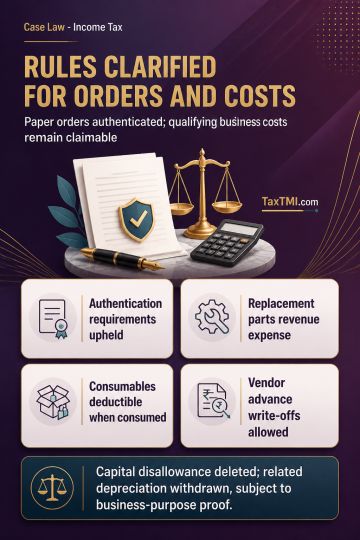
Authentication of paper assessment orders upheld, while qualifying repairs, consumables and vendor advance write-offs remain deductible business claim...
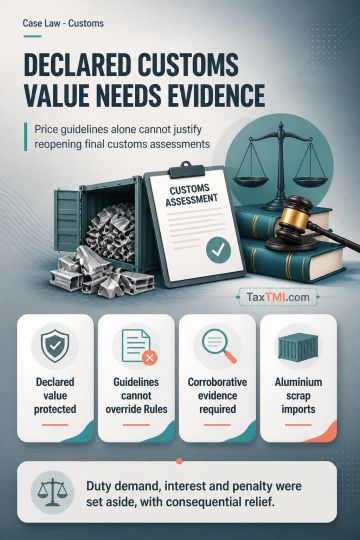
Transaction value cannot be rejected solely on non-statutory valuation guidelines without corroborative evidence supporting reassessment of final cust...
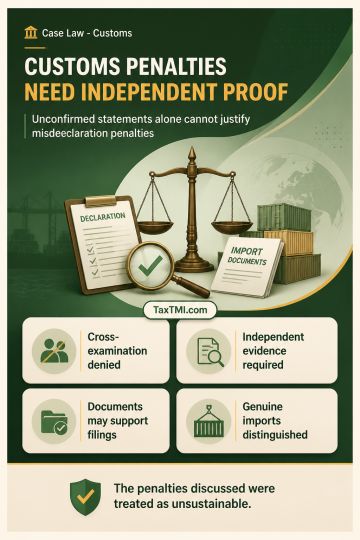
Cross-examination rights and corroborated evidence limit customs penalties for misdeclaration in genuine import transactions involving documented clea...
Page of 4782
Press 'Enter' after typing page number.
301 to 320 of 95636 Results
❮
❯
❯❯
0 / 200
Expand Note
Add to Folder
No Folders have been created
+
Are you sure you want to delete "My most important" ?
This instruction clarifies certain aspects of origin procedures under free trade agreements (FTAs), particularly regarding third-party invoicing. It emphasizes that the purpose of a certificate of origin (COO) is to serve as proof that goods qualify as originating under an FTA, irrespective of third-party invoicing. The seller's invoice, including a third-party invoice, is relevant for customs valuation. Where doubts arise about originating criteria, proper officers may seek information and supporting documents from importers, consistent with the FTA. If information is insufficient, verification with the issuing authority through the FTA Cell is triggered, following the Customs (Administration of Rules of Origin under Trade Agreements) Rules, 2020 (CAROTAR). The process must align with the FTA, without obligating importers to provide commercially confidential information or requiring specific currencies. Preferential duty claims can be denied without verification only if permitted by the FTA. Non-compliance must be established through due process, natural justice, and FTA obligations. Merely pointing out ineligible value addition elements may be insufficient to reject claims unless demonstrated that the prescribed value addition threshold is not met.
This instruction clarifies certain aspects of origin procedures under free trade agreements (FTAs), particularly regarding third-party invoicing. It emphasizes that the purpose of a certificate of origin (COO) is to serve as proof that goods qualify as originating under an FTA, irrespective of third-party invoicing. The seller's invoice, including a third-party invoice, is relevant for customs valuation. Where doubts arise about originating criteria, proper officers may seek information and supporting documents from importers, consistent with the FTA. If information is insufficient, verification with the issuing authority through the FTA Cell is triggered, following the Customs (Administration of Rules of Origin under Trade Agreements) Rules, 2020 (CAROTAR). The process must align with the FTA, without obligating importers to provide commercially confidential information or requiring specific currencies. Preferential duty claims can be denied without verification only if permitted by the FTA. Non-compliance must be established through due process, natural justice, and FTA obligations. Merely pointing out ineligible value addition elements may be insufficient to reject claims unless demonstrated that the prescribed value addition threshold is not met.
Note: It is a system-generated summary and is for quick reference only.
 TaxTMI
 of 4782









 Join Channel


 TaxTMI