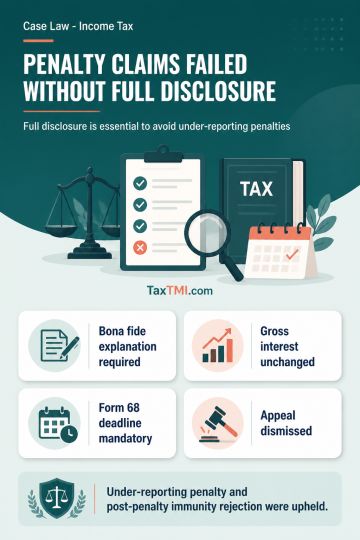
Bona fide disclosure requirements govern under-reporting penalties, and post-penalty immunity applications cannot secure available statutory protectio...
Certificate-of-origin verification procedure governs preferential customs benefits; denial without retroactive verification was set aside with consequ...
Disciplinary Committee jurisdiction and mandatory investigation requirements invalidated cancellation of an insolvency professional's registration and...
Retention of seized property survives where recorded reasons support proceeds of crime, while stayed investigation periods are excluded from limitatio...
The High Court held that the reopening notice issued u/s 148 against a non-existent entity, i.e., the amalgamating company that had ceased to exist due to an approved scheme of amalgamation, was invalid and illegal. Despite being informed about the amalgamation, the Assessing Officer issued the jurisdictional notice solely in the name of the amalgamating company, which was fundamentally at odds with the legal principle that the amalgamating entity ceases to exist upon the approved scheme of amalgamation. The appellant's participation in the proceedings cannot operate as an estoppel against law. The Assessing Officer lacked legal basis and jurisdiction to issue the impugned notice u/s 148A(b), pass an order thereon, and further issue the impugned notice u/s 148 to a non-existing entity. Such notices were illegal, invalid, and non-est from the outset. The decision was in favor of the assessee.
The High Court held that the reopening notice issued u/s 148 against a non-existent entity, i.e., the amalgamating company that had ceased to exist due to an approved scheme of amalgamation, was invalid and illegal. Despite being informed about the amalgamation, the Assessing Officer issued the jurisdictional notice solely in the name of the amalgamating company, which was fundamentally at odds with the legal principle that the amalgamating entity ceases to exist upon the approved scheme of amalgamation. The appellant's participation in the proceedings cannot operate as an estoppel against law. The Assessing Officer lacked legal basis and jurisdiction to issue the impugned notice u/s 148A(b), pass an order thereon, and further issue the impugned notice u/s 148 to a non-existing entity. Such notices were illegal, invalid, and non-est from the outset. The decision was in favor of the assessee.
Note: It is a system-generated summary and is for quick reference only.
 TaxTMI
 of 4796
















 Join Channel


 TaxTMI